
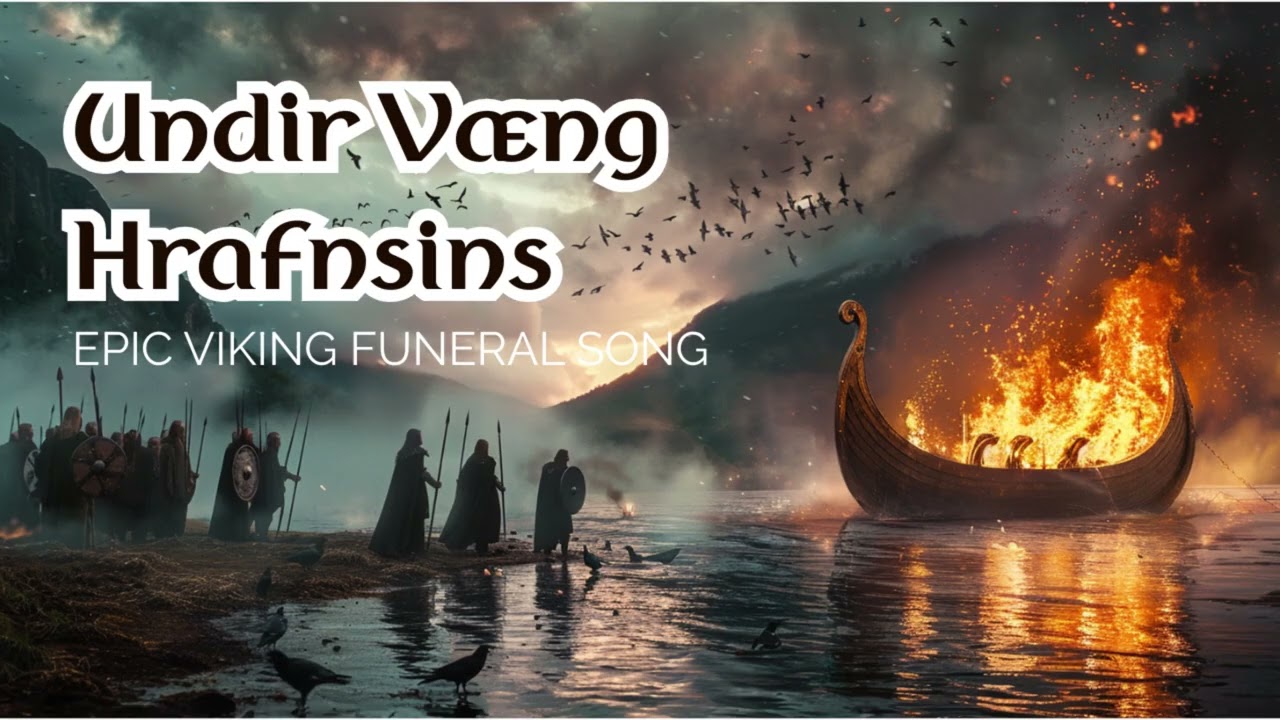
Undir Væng Hrafnsins (“Under the Raven’s Wing”) is a 5:05 Mythic Harmonies funeral song in Old Norse-styled language. Ravens cross a darkening sky above a blood-red field, the refrain gathers the fallen beneath a black wing, and a burning ship by the fjord turns battlefield death into a modern imagined passage toward Odin’s hall.
Play the complete master above. The corresponding distributed release is titled Under the raven’s wing and runs 5:04 on Spotify and Apple Music, within one second of the video. The composition is modern: its melody, wording and ravens-as-soul-guides are not presented as a surviving Viking Age funeral rite.
Undir Væng Hrafnsins at a Glance
| Artist | Mythic Harmonies |
|---|---|
| Song | Undir Væng Hrafnsins |
| English title | Under the Raven’s Wing |
| Duration | 5:05 on YouTube; 5:04 on Spotify and Apple Music |
| Language | Old Norse-styled text with English artistic translation |
| Core scene | Ravens, a fallen war-band and a burning ship beside a fjord |
| Status | Original modern composition, not a reconstructed funeral chant |
What Is the Song About?
The first lines place the listener above a battlefield: ravens fly, the sky darkens and the ground is red. The next verse moves from what the birds see to what the mourners imagine they do. The ravens sing, gather the fallen beneath a wing and lead them toward Valhalla. That movement becomes the refrain, where drifting souls and Odin’s gaze replace the physical field.
A later verse changes the setting without changing the direction. Smoke rises from a ship burning beside a fjord; the ravens watch and continue the passage. The final stanza returns to those left behind—“our kin depart”—and lets praise outlast death. The song’s progression is therefore battlefield aftermath → shelter beneath the wing → imagined journey to Odin → fire by the fjord → remembrance by the living.
The black wing is the track’s central invention. It can be heard as shelter and as the shadow of death at the same time. That ambiguity gives this song its own identity: the birds are not merely a visual omen, and the funeral is not merely a ship scene; both become part of one imagined escort.
What Does “Undir Væng Hrafnsins” Mean?
Undir means “under” or “beneath,” vængr means “wing,” and hrafnsins is the definite genitive “of the raven.” The intended title is therefore Under the Raven’s Wing. The form væng is compatible with the governed singular form here, so the title itself is understandable Old Norse.
Its protective meaning belongs to the composition. No cited Eddic stanza uses this phrase as the name of a funeral rite, describes Odin shielding souls beneath a raven’s wing or makes the wing a route from Hel to Asgard.
Are the Ravens Huginn and Muninn?
The lyric calls the birds “Odin’s messengers,” but it never names Huginn or Muninn. Grímnismál 20 does name Odin’s two ravens and says they fly over the earth each day; Snorri’s prose account adds that they bring him news. Those sources support the association between Odin, information and the two birds.
They do not clearly say that Huginn and Muninn collect souls, escort every warrior to Valhalla or act as a standard Norse psychopomp. Ravens also belong to the visual language of battle poetry because carrion birds follow slaughter, and Odin has strong connections with war and the slain. The song fuses those real literary associations into a new role: its ravens watch, sing and guide.
The Burning Ship and Valhalla
“A ship burns by the fjord’s cold wall” is a scene inside this song, not a complete description of one standard Viking funeral. Archaeology records cremation, inhumation, boat graves, large ship burials and regional variation. Famous ship burials such as Gokstad and Oseberg were placed in graves on land; a burning vessel released across the water is the familiar modern image, not a universal archaeological pattern.
Valhalla is likewise the destination chosen by the lyric. Medieval material does connect Odin with selected slain warriors, but Grímnismál 14 assigns half of the slain to Freyja and half to Odin. The ravens’ escort and the certainty of arrival are therefore the mourners’ poetic vision. For the broader evidence, read the sourced guide to Viking funeral rites and the Viking Ship Museum’s overview of burials and ship graves.
How the Arrangement Shapes the Dirge
The recording gives its refrain room to gather weight. Low, widely spaced percussion creates a slow processional pulse, sustained textures keep the field and fjord connected, and layered voices broaden the moment when the fallen move “under the raven’s wing.” The verses narrate; the repeated refrain suspends the action and turns it into ceremony.
These are observations about the 2025 recording, not a reconstruction of historical funeral music. No complete score survives for a Viking Age song matching these words, instruments or arrangement. A listener may choose it for private remembrance or fictional storytelling, but the fiche does not claim documented use by ancient mourners or a modern religious community.
Old Norse Language Note
The original-language block is reproduced exactly as released. It combines recognizable Old Norse words with modern compression and unstable grammar. Examples include himinn sortn where a finite verb such as sortnar would be expected; Óðins sendir, where sendir reads more naturally as a verb than the plural noun “messengers”; and sálir bortn, whose final word is not normal Old Norse.
Agreement and case also shift in blóðr á vǫllr, jǫrðr er rautt, undir vængi hrafnsins svǫrt, Reykir rís af eldi stór and við fjǫrðrinn. Plural subjects require plural verbs in phrases such as hrafnar syng and hrafnar kallar. Several English lines—including souls being tracked, an “eternal oath” and “glory bright”—are interpretive rather than literal translations. The safest label is therefore Old Norse-styled lyrics with an English artistic adaptation, not normalized medieval prose or verse.
Where This Fiche Fits
This page owns the 5:05 Undir Væng Hrafnsins recording, its black-wing refrain, raven escort, battlefield-to-fjord sequence and exact bilingual text. Viking Funeral at Sea keeps the separate English 5:16 burning-ship farewell and “carry him home” chorus. Tár Hrafn owns a different raven-and-grief composition. The historical guide owns the general funeral question.
Undir Væng Hrafnsins Lyrics & Translation
The published Old Norse-styled text and English artistic translation are reproduced below without silent correction.
Original Old Norse-Styled Text
Hrafnar fljúga, himinn sortn, Óðins sendir, sálir bortn.
Blóðr á vǫllr, jǫrðr er rautt, Herir falla, ævi hlaut. Í skugga nótt, þeir hrafnar syng, Leiða menn undir vængr.
Undir vængi hrafnsins svǫrt, Sálir svífa, dauðr er hjǫrt. Til Valhǫlls hallar þeir fara nú, Í Óðins augum, eilífr trú.
Reykir rís af eldi stór, Skip brennr við fjǫrðrinn stór. Hrafnar vaka, fylgja þá, Til himins hallar, leiða sjá.
Undir vængi hrafnsins svǫrt, Sálir svífa, dauðr er hjǫrt. Til Valhǫlls hallar þeir fara nú, Í Óðins augum, eilífr trú.
Hrafnar kallar, ættir rann, Í dauða ljóma, draumr vér fann. Í vængi svart, í eldi bjart, Ævi endar, en lof er spart.
English Artistic Translation
The ravens fly, the sky grows black, Odin’s messengers, souls they track.
Blood on the field, the earth runs red, Warriors fall, their lives now fled. In shadows dark, the ravens sing, They guide the men beneath their wing.
Under the raven’s wing so black, Souls now drift, no turning back. To Odin’s hall the fallen go, In his gaze, eternal oath.
Smoke now rises, fire tall, A ship burns by the fjord’s cold wall. The ravens watch and guide their way, To Odin’s hall at end of day.
Under the raven’s wing so black, Souls now drift, no turning back. To Odin’s hall the fallen go, In his gaze, eternal oath.
The ravens call, our kin depart, In death’s bright flame, we bear the mark. In wings of night, in fire’s light, Life has ended, yet glory bright.
Listen on Spotify and Apple Music
The exact distributed release appears under its English title: Under the raven’s wing on Spotify and Under the raven’s wing on Apple Music, both 5:04. They match the 5:05 YouTube master within one second. Browse every full text in the Songbook of the North.
Sources and Editorial Method
- Edward Pettit (ed.), Grímnismál, especially stanzas 14 and 20 for the divided slain and Huginn and Muninn.
- Anthony Faulkes (ed.), Snorri Sturluson: Edda. Prologue and Gylfaginning, for Odin’s ravens returning with news.
- National Museum of Denmark, “The Viking gods”, for the material and literary association of Odin with his two ravens.
- Viking Ship Museum, Roskilde, “Dead and buried”, for the diversity of burial evidence and ship graves.
- Michael Barnes, A New Introduction to Old Norse, Part I: Grammar, for the language note.
Editorial note: the sources establish Odin’s ravens, selected slain, burial variety and the grammatical baseline. The black-wing shelter, soul escort, burning-fjord sequence, words and music are modern choices made for this composition.
Frequently Asked Questions
What does Undir Væng Hrafnsins mean?
It means “Under the Raven’s Wing.” The phrase is the title of this modern song; its image of a protective black wing is not presented as the name of an attested Viking funeral rite.
What is Undir Væng Hrafnsins about?
Ravens cross a dark battlefield, gather the fallen beneath their wing and guide them toward Odin while a ship burns beside a fjord. The final stanza turns the imagined passage into remembrance by surviving kin.
Are the ravens Huginn and Muninn?
The lyric calls them Odin’s messengers but never names them. Medieval sources say Huginn and Muninn fly over the earth and bring Odin news; they do not clearly establish the pair as universal guides of dead souls.
Is this an authentic Viking funeral song?
No. It is an original modern Mythic Harmonies composition in Old Norse-styled language. Its melody, exact words, raven escort and burning-fjord scene are not a surviving Viking Age chant.
Where can I listen to Undir Væng Hrafnsins?
The 5:05 YouTube master is embedded at the top. The matching release is titled Under the raven’s wing and runs 5:04 on both Spotify and Apple Music, linked directly below the lyrics.
More from Funeral & Ritual
March with the War-Band
New Old Norse chants every month. Join the listeners who never miss a release.