
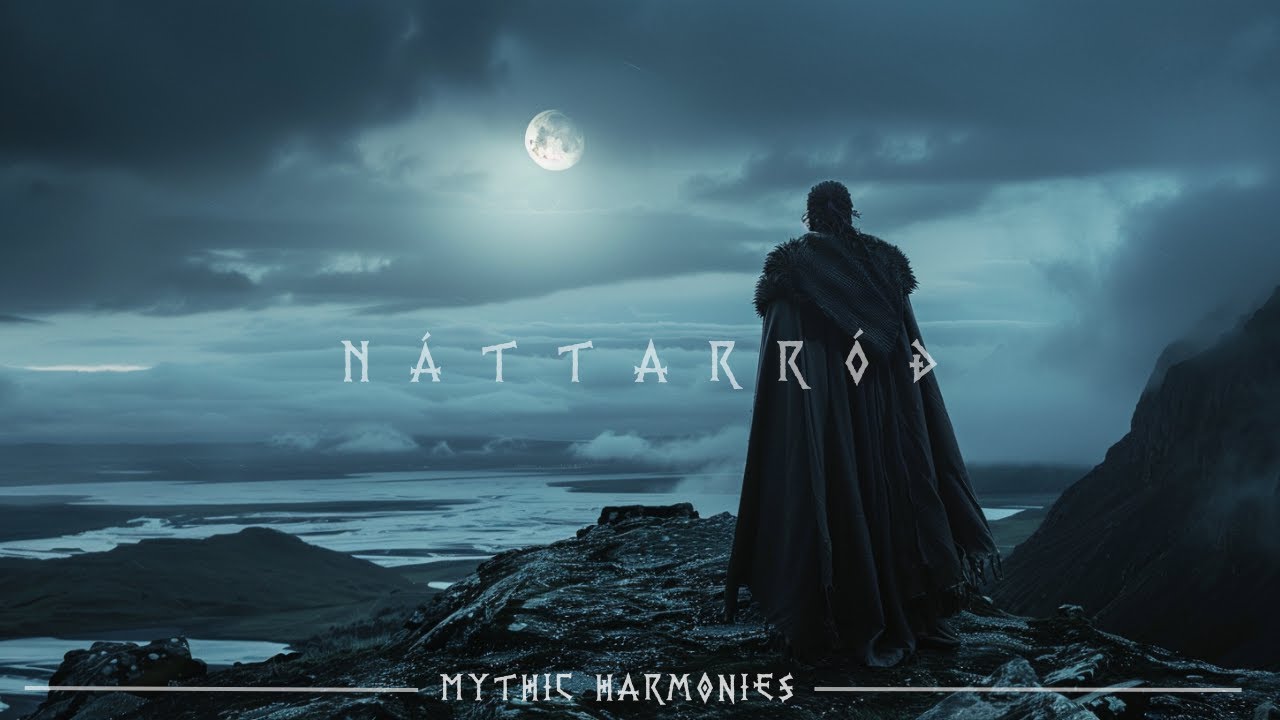
Náttarróð is a 3:07 Mythic Harmonies night song built from mountain slopes, starlight, sea, mist and a recurring call along a dark path. Its movement is inward rather than martial: the night sings, old memories rise, and the final voice continues whispering after the refrain has ended.
This music fiche identifies the recording, explains its published “Night Call” meaning, follows its quiet lyric sequence and separates the song’s unnamed spirits and dreams from claims about a universal Norse worldview. The complete released text and English artistic adaptation are preserved below.
Náttarróð at a Glance
- Song: Náttarróð
- Published English identity: “Night Call of the North”
- Artist: Mythic Harmonies
- Runtime: 3:07 on YouTube; 3:06 on Spotify and Apple Music
- Album: Shadows over Midgard: Echoes of Ragnarok
- Language: stylized Old Norse with a published English artistic adaptation
- Song focus: a nocturnal inward journey through landscape, memory and whispering voices
What Does Náttarróð Mean?
The recording is published in English as “Night Call of the North,” and its refrain makes “the night’s call” the intended meaning. The first element clearly points to night. The complete compound, however, should be treated as a stylized song title rather than a securely attested medieval phrase with one automatic dictionary translation.
Old Norse words in the róðr family can relate to rowing or a journey by oar, which makes “call” an artistic title identity rather than a transparent lexical equation. That ambiguity suits the text: the refrain can be heard as a call, while the repeated dark path also gives the song the shape of a night journey.
What Story Does the Song Tell?
The opening verse establishes a listening landscape. Night sings along a mountain slope, cold spirits move with time, starlight reaches the ground and the heart becomes quiet. No narrator is introduced through biography; the place and its sounds lead.
Wind, shadows and mountains deepen that scene before the refrain finally turns toward a speaker. The night’s call reaches “me,” a cold spirit accompanies the path, and the mind is guided inward. Sea and returning memories then widen the setting, followed by a short bridge in which mist lifts and the soul sings.
The second refrain changes “guides my mind” to “holds my mind,” slowing the movement. Two final lines—“The night whispers / Still whispering”—leave the track unresolved. Its arc is landscape → call → memory → quiet continuation, not a narrated supernatural encounter with a named being.
How Náttarróð Creates a Night Journey
The song relies on repeated verbs of sound: sings, whispers, calls and sings again. Visual images—stars, shadows, sea, mist—never replace that acoustic thread. Even the mountains “hold the ancient voice,” so the landscape seems to store sound before returning it to the speaker.
The refrain is the only section to name the title twice. Its dark path gives direction to an otherwise suspended scene, while “deep and inward” defines the destination emotionally rather than geographically. The result is contemplative, but that quality belongs to the composition; it is not evidence of an ancient meditation method.
Who Are the “Cold Spirits”?
The lyrics do not say. They do not name landvættir, ancestors, draugar, elves or gods. “Cold spirits” can therefore remain atmospheric presences within the song instead of being assigned to a specific category from medieval literature.
Old Norse sources do contain many kinds of non-human beings and dead figures, but their roles vary by text, genre and period. That evidence does not justify the blanket claim that every mountain was considered conscious, that darkness made a “veil between worlds” universally thin, or that a lone night traveller was never believed to be alone. Náttarróð creates its own haunted landscape without needing those modern generalizations.
Dreams, Memory and the Unseen
Dreams matter to the song as paths and streams rather than as one prophetic message. Wind moves along a dream-path; later, night watches over a flow of dreams. Between them, old memories rise and faded words are kept. Dream and memory are therefore linked by recurrence: what seems lost returns in darkness.
Dreams can carry warnings or knowledge in medieval Norse literature—Baldrs draumar, for example, begins from Baldr’s troubling dreams—but one poem or saga motif does not establish a single belief held identically by everyone. No dream in Náttarróð predicts an event. Its inward movement is lyrical and modern.
Does the Song Refer to the Norse Goddess Nótt?
Not explicitly. Snorri personifies Night as Nótt and describes her travelling across the sky with the horse Hrímfaxi. The song repeatedly says “the night,” but it does not use Nótt as a named character, mention Hrímfaxi or retell that genealogy.
The distinction preserves what the recording actually does: night itself receives voice and action, but the listener is not required to identify that poetic personification with Snorri’s figure. The overlap is a possible resonance, not a hidden plot point.
Language and Translation Transparency
The released transcription is stylized rather than consistently normalized Old Norse. Forms and phrases including næturund, norðrsins móð, Vega sál í dýpstu kvǫdd, Náttarróð kallar mér, djúpt og hrjót, Sjórinn hvelfir undir ljós, Gǫmul minni rísa ljóss, drauma rann, Þokur lyftast hægur vindr and the mixture of ok/og are preserved as released without being presented as normalized prose.
The English text is an artistic adaptation. “Breath of the North,” “deepest chant,” “guiding my mind deep and inward,” “old memories rise again” and “flow of dreams” clarify the intended scene but are not exact word-for-word glosses of every form in the first block.
Is Náttarróð an Authentic Viking Age Song?
No. Náttarróð is an original modern Mythic Harmonies composition. Its vocabulary and northern landscape are historically inspired, but no runic inscription or medieval manuscript preserves this title, complete lyric, refrain, melody or night-spirit scene.
Calling it an Old Norse or Viking song describes its creative language and genre. It does not make the track a recovered ritual, an ancient sleep song or a historically verified meditation practice.
How This Music Fiche Stays Distinct
Náttarróð owns the 3:07 night-call recording, its dark path, cold companion, returning memories and final “still whispering” couplet. Draumar við Fjǫrðinn owns the sleeping fjord and its separate dream-song master; Dagr ok Nótt owns a farewell between day and night; Frosinn Dómr owns frozen judgment.
Those boundaries keep the page aligned with searches for this track, its lyrics, translation, meaning and listening links. It does not compete for a broad history of Norse dreams, spirits or cosmology.
Source Notes
- Dictionary of Old Norse Prose, University of Copenhagen: lexical evidence for night, voice, dream, spirit and the róðr word family.
- A New Introduction to Old Norse, Part III: Glossary, Viking Society for Northern Research: independent control for normalized vocabulary and inflection.
- The Poetic Edda, edited and translated by Edward Pettit: Baldrs draumar as a documented poetic dream context, not proof of a universal dream doctrine.
- Snorri Sturluson: Edda—Prologue and Gylfaginning, edited by Anthony Faulkes: Snorri’s distinct personification of Nótt and Hrímfaxi.
Where to Listen to Náttarróð
Watch the official 3:07 Náttarróð video at the top of this fiche. The same Mythic Harmonies master is listed at 3:06 on Spotify and Apple Music. Title and artist match exactly, and the duration differs by one second.
Náttarróð Lyrics & English Adaptation
The two blocks preserve the released transcription and English artistic adaptation exactly. They are not silently normalized or presented as a medieval poem.
Original Text (Stylized Old Norse)
Nóttin syngr um fjallsins hlíð
Kaldir andar fylgja tíð
Ljós af stjǫrnum fellr á grund
Hjarta þagnar í næturundVindar hvísla um drauma slóð
Skuggar dansa í norðrsins móð
Fjǫllin halda forna rǫdd
Vega sál í dýpstu kvǫddNáttarróð kallar mér
Kaldur andi fylgir hér
Náttarróð um myrka braut
Leiðir hug minn djúpt og hrjótSjórinn hvelfir undir ljós
Gǫmul minni rísa ljóss
Nóttin geymir orð sem svann
Vakar yfir drauma rannÞokur lyftast hægur vindr
Syngur sál í kyrrum myndNáttarróð kallar mér
Kaldur andi fylgir hér
Náttarróð um myrka braut
Heldr við hug minn djúpt og hrjótNóttin hvíslar
Hvíslar enn
English Artistic Adaptation
The night sings along the mountain’s side
Cold spirits follow the flow of time
Light from the stars falls upon the ground
The heart grows silent in the night’s momentWinds whisper along the path of dreams
Shadows dance in the breath of the North
The mountains hold the ancient voice
Weighing the soul in the deepest chantThe night’s call reaches me
A cold spirit walks beside me
The night’s call along a dark path
Guiding my mind deep and inwardThe sea arches beneath the light
Old memories rise again
The night keeps words that once faded
Watching over the flow of dreamsMists lift in a gentle wind
The soul sings in a quiet formThe night’s call reaches me
A cold spirit walks beside me
The night’s call along a dark path
Holding my mind deep and inwardThe night whispers
Still whispering
What does Náttarróð mean?
The recording is published as “Night Call of the North,” and its refrain uses “the night’s call.” The compound is a stylized title rather than a securely attested medieval phrase with one automatic dictionary translation.
What is the song Náttarróð about?
It follows a nocturnal inward journey through mountains, starlight, sea and mist. A cold companion accompanies the speaker, old memories return, and the song ends with the night still whispering.
Who are the cold spirits in Náttarróð?
The lyrics do not identify them as landvættir, ancestors, draugar, elves or gods. They remain unnamed atmospheric presences within this modern song.
Is Náttarróð an authentic Viking Age song?
No. It is an original modern Mythic Harmonies composition in stylized Old Norse. No medieval source preserves this complete lyric, refrain, melody or night-spirit scene.
Where can I listen to Náttarróð?
The official video runs 3:07 on YouTube. The same Mythic Harmonies master appears as Náttarróð at 3:06 on Spotify and Apple Music, matching title and artist within the one-second duration tolerance.
More from Funeral & Ritual
March with the War-Band
New Old Norse chants every month. Join the listeners who never miss a release.