
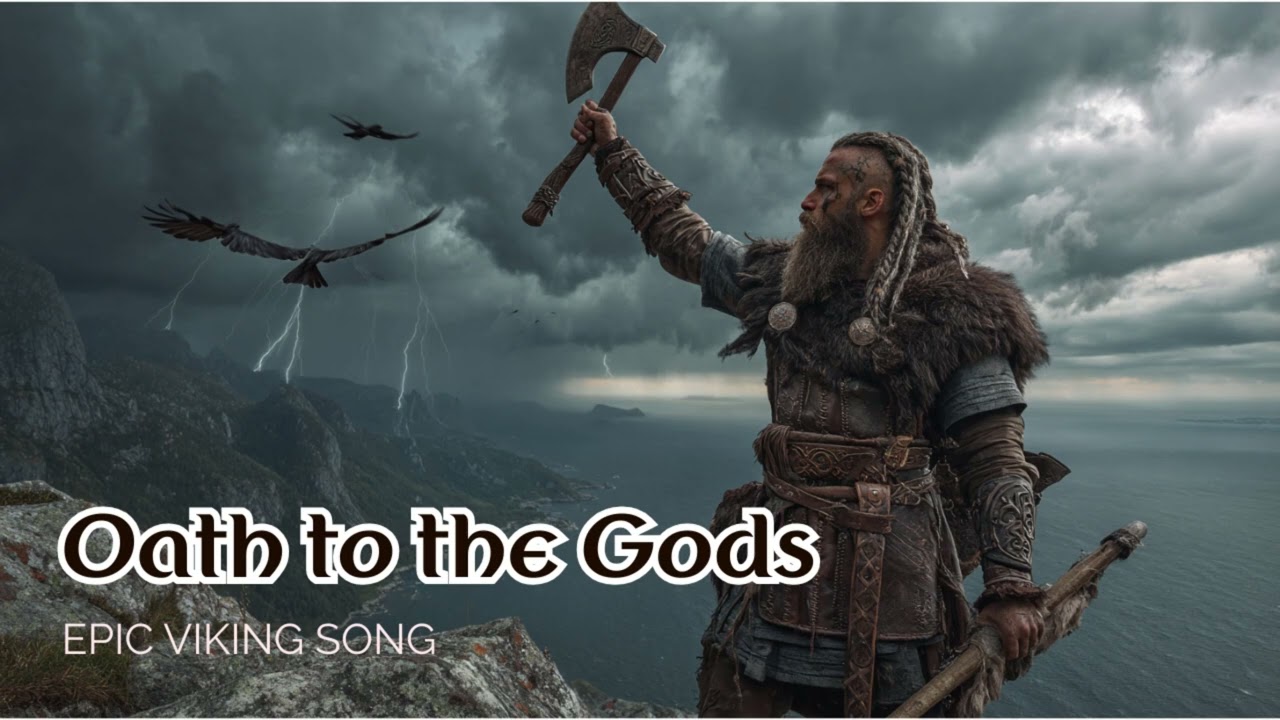
Oath to the Gods is an original English-language Mythic Harmonies song about a warrior making a vow at the edge of battle. Odin, Thor, a raven, a shield wall and Valhalla give the promise its Norse setting; the repeated line “we stand our ground” gives it its emotional centre.
The official video runs 4:29. The song is not a translated Viking Age oath or a recovered battle prayer. Oaths, sacred rings and divine names do appear in medieval and contemporary evidence, but these words, this combination of gods and this musical arrangement are modern creative work.
Oath to the Gods at a Glance
- Title: Oath to the Gods.
- Artist: Mythic Harmonies.
- Language: English.
- Length: 4:29 on YouTube; 4:28 on Spotify and Apple Music.
- Core theme: commitment under pressure, expressed through a modern Norse battle scene.
- Historical status: contemporary Nordic-inspired music, not a surviving oath formula.
What Is Oath to the Gods About?
The song follows one movement from invocation to resolve. The opening speaker names Odin and Thor and asks for help in the coming fight. The refrain then changes from “I” to “we”: blood, fire, frost and fate become the shared conditions under which the group refuses to yield.
The third verse adds the raven and shield wall, then imagines enemies breaking. The final verse accepts the possibility of death and looks toward Valhalla. Its purpose is motivational, not documentary. The narrative compresses several familiar Norse images into one English battle anthem.
That focus differentiates it from nearby songs. The Blood Oath examines a bond between companions and the specific turf-arch episode in Gísla saga. Skjaldborg til Valhǫllu owns the shield-wall term and its evidence. Oath to the Gods is the English vow-song that invokes Odin and Thor.
What Do the Sources Say About Norse Oaths?
The noun eiðr means an oath in medieval Norse texts. Law, poetry and saga narrative all show that sworn commitments could carry social and legal force. The University of Copenhagen’s ONP dictionary and corpus is the appropriate resource for checking the word across surviving prose texts; it does not reduce every oath to one religious ceremony.
A useful synthesis appears in a peer-reviewed Archaeological Dialogues study. It brings together eddic poetry, sagas, archaeology and external records. The Anglo-Saxon Chronicle’s entry for 876 reports that a Viking army swore oaths on a sacred ring during an agreement with Alfred. Hávamál 110 refers to an oath made on a ring, while Atlakviða names Ullr’s ring.
The evidence is significant but uneven. The Chronicle is comparatively close to the event but describes diplomacy, not a prayer before a charge. Eddic poems survive in later manuscripts. Saga temple rings are later literary testimony. Archaeological rings can have several possible functions, and calling every example an “oath ring” would decide the interpretation before the evidence does.
We can therefore say that oath-taking and ring oaths are genuinely documented. We cannot recover one universal speech called “Oath to the Gods,” prove that it was shouted by shield walls, or attach this song’s refrain to a historical rite.
Odin and Thor: Invocation or Historical Formula?
The first verse gives Odin hearing and Thor might. Those roles make intuitive sense within modern Norse-inspired storytelling: Odin is repeatedly connected with war, poetry and knowledge; Thor is the hammer-bearing defender who confronts giants. But the lyric’s paired appeal is not quoted from an eddic poem, runestone or law code.
The Uppsala Edda offers a medieval systematisation of the gods and their attributes. It is indispensable evidence for how Snorri’s tradition presented them, yet the manuscript dates centuries after the Viking Age and is not a field record of pre-battle worship.
Even Odin’s relation to oaths is not a simple guarantee of honesty. Hávamál 110 accuses Odin of a ring oath in the story of the mead and immediately asks how his pledges can be trusted. The accessible text and translation in Saga-Book XXIX preserve that deliberately uneasy conclusion. The source complicates the song’s solemn invocation rather than confirming it.
The Shield Wall, Raven and Bound Fate
Three lines create most of the visual world: the raven makes an omen, the shield wall stands and fate is bound. Each is a modern poetic statement. The raven can evoke Odin and the battlefield, but no source makes every bird a clear personal message. The complete historical discussion belongs on the linked Skjaldborg fiche; here the wall is one line in the song, not its primary keyword.
“Our fate is bound” expresses determination under uncertainty. The previous page called this “Wyrd,” but wyrd is the Old English form, not a universal label that explains every Norse attitude. The cognate Urðr is the name of one Norn and a noun connected with what has happened or become. Neither term proves that Scandinavians believed the exact date of every death was fixed at birth, that fear was pointless or that glory mattered more than survival.
The final Valhalla verse is equally specific to the song. Medieval sources connect Odin’s hall with selected battle-dead, but they do not promise that any person who falls beside a sword and shield automatically enters a golden hall. The speaker’s confidence is part of the anthem’s character.
How the Arrangement Turns a Vow into an Anthem
The recording begins by leaving room around the individual invocation. When the refrain arrives, the vocal weight expands and the pronouns change to a group. That transition is the musical equivalent of an oath becoming public: a private request becomes a collective statement that can be repeated.
Heavy, regular percussion keeps the chorus easy to anticipate, while the verse melody carries more narrative detail. Repetition does not add new historical information; it tests the same promise under different images—battle, omen and possible death. By the final refrain, the listener already knows the words and can enter them.
That structure makes the track useful for training, gaming or any fictional scene built around resolve. It does not make the music a reconstruction of Viking practice. For the wider distinction between modern production and surviving evidence, see the guide to Viking and Nordic-inspired music.
Oath to the Gods Lyrics
These are the complete released English lyrics. They are original modern writing, not a translation of Hávamál, a saga oath or a Viking Age inscription.
Beneath the sky of steel and flame, I call the gods and speak their name, Odin hear, and Thor give might, Guide my axe in the coming fight.
Oath to the gods, we shall not fall, Blood on the earth, we heed the call, Through fire and frost, our fate is bound, In death or glory, we stand our ground.
The raven flies, the omen’s clear, The shield-wall stands, we show no fear, The sea will roar, the earth will shake, Our enemies shall break and quake.
Oath to the gods, we shall not fall, Blood on the earth, we heed the call, Through fire and frost, our fate is bound, In death or glory, we stand our ground.
If I should fall, then let me lie, Where sword and shield beneath me die, And in Valhalla’s golden hall, I’ll feast and drink, my brothers all.
Oath to the gods, we shall not fall, Blood on the earth, we heed the call, Through fire and frost, our fate is bound, In death or glory, we stand our ground.
Where to Stream Oath to the Gods
The official YouTube video runs 4:29. The exact Mythic Harmonies release lasts 4:28 on Spotify and Apple Music. The title matches exactly and the one-second difference passes the site’s verification rule.
Sources and Further Reading
- Neil Price, “New institutional economics in Viking studies”, Archaeological Dialogues 29, for oath rings, written sources and material interpretation.
- Saga-Book XXIX, Viking Society for Northern Research, for the text and translation of Hávamál 110 and Odin’s ring oath.
- The Uppsala Edda: DG 11 4to, ed. Heimir Pálsson, for medieval presentations of Odin, Thor and Valhalla.
- ONP dictionary and corpus, University of Copenhagen, for eiðr and the wider prose evidence.
For every available song text in one place, continue to the Songbook of the North.
What is Oath to the Gods about?
It is an English battle anthem about a warrior invoking Odin and Thor, joining a collective vow and standing firm despite the possibility of death. The Norse setting is modern creative work rather than a translation of a historical oath.
Is Oath to the Gods an authentic Viking chant?
No. It is a modern Mythic Harmonies composition. Oaths and sacred-ring oaths are documented in poetry, saga literature and an Anglo-Saxon Chronicle entry, but none preserves this lyric, melody or paired invocation of Odin and Thor.
Did Vikings swear oaths to the gods?
Oath-taking is well documented, including a Viking army swearing on a sacred ring in 876 and ring oaths in eddic poetry. The evidence varies by date and genre, however, and it does not give us one universal pre-battle oath addressed to the gods.
What language is Oath to the Gods sung in?
The song is sung entirely in English. Norse names and images appear in the words, but there is no Norse-language lyric or translation section for this release.
Where can I stream Oath to the Gods?
The exact Mythic Harmonies release is on YouTube at 4:29 and on Spotify and Apple Music at 4:28. The exact title matches on all three platforms, and the one-second difference meets the catalogue’s verification rule.
More from Epic War Battle
March with the War-Band
New Old Norse chants every month. Join the listeners who never miss a release.