
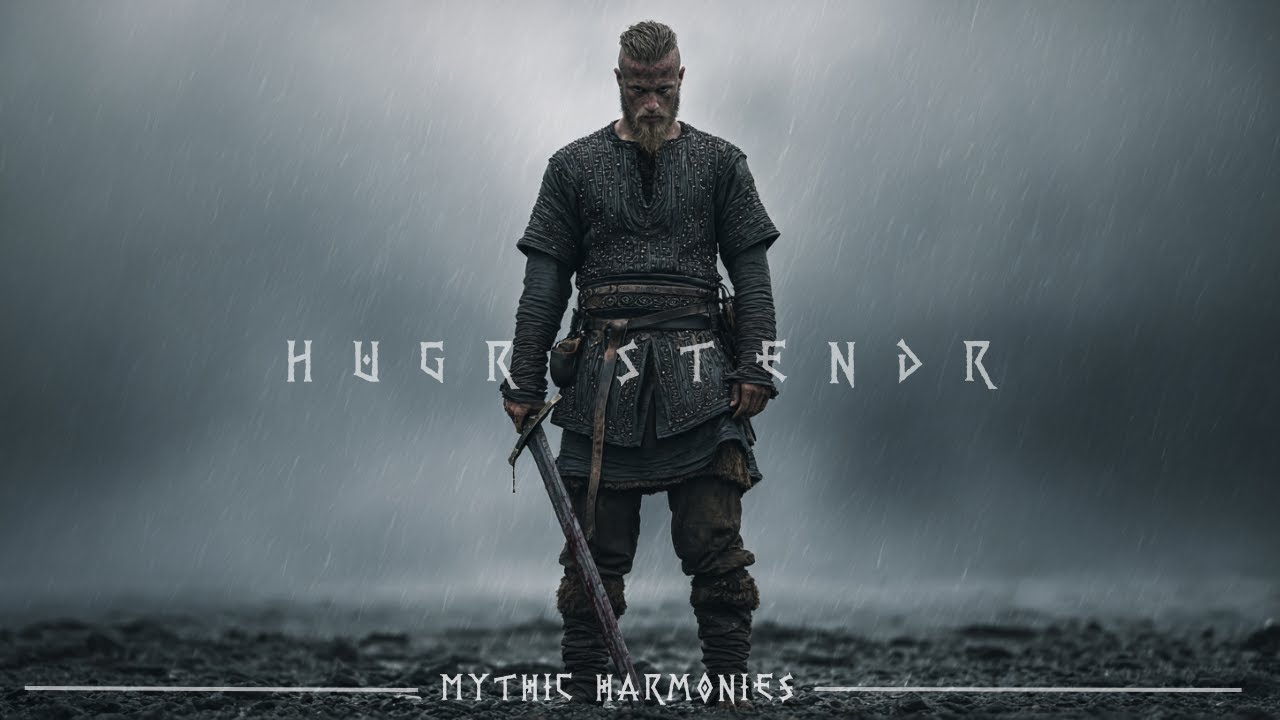
Hugr Stendr (“The Mind Stands”) is a 2:35 Mythic Harmonies song about continuing when the body is wounded and exhausted. Wind, cold skin, wet earth and night press against a speaker whose repeated answer is simple: the mind stands, the will lives, and “I bend, but I do not break.”
This music fiche identifies the recording, explains its title and refrain, separates the Old Norse word hugr from a rigid modern “Norse soul system,” and preserves the complete published text and English adaptation. The track is a modern work of endurance, not a recovered Viking warrior creed or medical promise.
Hugr Stendr at a Glance
- Site title: Hugr Stendr (“The Mind Stands”)
- Distributed title: Húðr Stendr
- Artist: Mythic Harmonies
- Runtime: 2:35 on YouTube; 2:34 on Spotify and Apple Music
- Language: stylized Old Norse with a published English artistic adaptation
- Song focus: bodily exhaustion answered by continued mental resolve
- Central line: Ek beygist, en ek brotna ei—published as “I bend, but I do not break”
What Does Hugr Stendr Mean?
Hugr can mean mind, thought, intention, disposition, courage or spirit depending on context, while stendr is “stands.” Hugr Stendr therefore means “The Mind Stands” or “The Will Stands” in the sense intended by this song. The refrain confirms that reading by opposing hugr to tired flesh and pairing it with vilji, will.
Spotify and Apple Music catalogue the same master as Húðr Stendr. That spelling is not a linguistic equivalent of Hugr Stendr: húð points to skin or hide. The one-second duration match, artist, album and the Spotify link already embedded in the original fiche establish the distribution identity, but the title difference remains disclosed rather than silently treated as correct Old Norse.
What Story Does the Song Tell?
The opening gives the song its proposition in two short clauses: the mind stands and does not fall. A first verse then places the speaker in hard wind and wet earth with an open wound, dry blood and a will that still lives in the chest. The body is not invulnerable; it is already under strain.
A one-line response—“I bend, but I do not break”—leads into the fourfold refrain. Day then becomes night, eyes burn, and the body grows heavy. No external witness answers. The only voice left is the mind telling the speaker to hold on. After the refrain repeats, the final variation moves from endurance under weight to endurance “until the end.”
The track’s arc is therefore physical pressure → private instruction → renewed refrain. It does not narrate a battle, name an enemy or promise victory. Its subject is persistence while the outcome remains unknown.
How the Refrain Builds Endurance
Each refrain line begins with Hugr stendr. The repetitions then add four tests: silence, weight, tiring flesh and the possibility of falling. Because the same two words survive every variation, grammar becomes the song’s rhythmic anchor.
The last refrain changes its companion phrases to “alone,” “until the end,” “the will lives” and “where men stand.” That shift widens a private struggle into a collective-sounding declaration, but the wording still belongs to this narrator. The isolated final “Hugr… stendr…” slows the claim to its smallest possible form.
What Does Hugr Mean in Old Norse?
Hugr has a broad semantic range. Dictionaries record senses involving mind, thought, intention, wish, mood, courage and spirit. In some medieval narratives it can be imagined as active beyond ordinary conscious thought. That variety is why a single English equivalent cannot cover every occurrence.
It is less responsible to define hugr as one fixed “part of the Norse soul,” the biological core of every person or a force always valued above the body. This song selects one part of the word’s range—resolve—and makes it speak as an inner voice. The artistic choice is effective without becoming a complete anthropology of the Viking self.
Body, Wound and Inner Voice
The verses keep mind and body in tension. Foot, skin, wound, blood, chest, eyes and flesh are concrete; hugr and vilji answer them with mental language. “My will still lives in my chest” gives resolve a bodily location, but it is poetic embodiment rather than an anatomical doctrine.
The command haltu can mean “hold” or “keep/stop” according to construction. “Endure” is the published artistic solution, chosen to fit the scene. The line does not prove a named spirit speaking from outside the body; within the song, it is the speaker’s own mind addressing itself when no one else hears.
Endurance Is the Song’s Claim, Not a Universal Viking Code
Old Norse poetry often values courage, reputation, prudence and steadiness under danger, but no single line turns every Scandinavian society into one timeless cult of unbreakable will. Law, family obligation, social status, genre and circumstance all shaped what surviving texts praise or condemn.
“I bend, but I do not break” is not presented in the sources as an ancient proverb. It is this modern song’s hook. Calling it “deeply Norse” without qualification would confuse an effective contemporary slogan with documented historical language.
Is Hugr Stendr an Authentic Viking Age Song?
No. Hugr Stendr is an original modern Mythic Harmonies composition. No runic inscription or medieval manuscript preserves this complete text, melody, refrain or wounded-speaker scene. The word hugr is historical; the song built around it is contemporary.
The transcription is stylized rather than uniformly normalized. Forms such as á kalda kind, fótr minn stendr, Sár er opit, blóð er þurrt, Hugr stendr! Undir þunga!, nóttin, lík er þungt, Einn ok harðr and Þar sem menn are preserved without being presented as exact equivalents of every English phrase.
How This Fiche Stays Distinct
Hugr Stendr owns the 2:35 recording, the wounded lone speaker, the repeated mind-stands refrain and “I bend, but I do not break.” Syng Rúnar owns a communal rune-song journey; Frosinn Dómr owns frozen aftermath and delayed judgment; Skjǫldr ok Sál owns shield-and-soul imagery.
The boundaries keep this page on a music query rather than competing for a general “Norse soul,” “Viking courage” or mental-health topic. Related fiches remain separate recordings with their own words and platforms.
Source Notes
- Dictionary of Old Norse Prose, University of Copenhagen: lexical range of hugr, vilji, standa, halda and the forms used by the song.
- A New Introduction to Old Norse, Part III: Glossary, Viking Society for Northern Research: an independent philological reference for vocabulary and normalized forms.
- The Poetic Edda, edited and translated by Edward Pettit: primary poetic context for historically attested praise of courage, prudence, reputation and endurance without turning one song hook into a universal code.
Where to Listen to Hugr Stendr
Watch the official 2:35 Hugr Stendr video at the top of this fiche. The paired Mythic Harmonies master is catalogued as Húðr Stendr at 2:34 on Spotify and Apple Music. The artist, album, adjacent catalogue identity and duration agree within one second; the spelling difference is disclosed above.
Hugr Stendr Lyrics & English Adaptation
The two blocks preserve the released transcription and English artistic adaptation exactly. They are not silently normalized or presented as a medieval poem.
Original Text (Stylized Old Norse)
Hugr stendr. Hugr fellr ei.
Vindr blæs harðr á kalda kind,
fótr minn stendr í blautri jǫrð.
Sár er opit, blóð er þurrt,
vilji minn er enn í brjósti.Ek beygist, en ek brotna ei.
Hugr stendr! Fast ok hljóðr!
Hugr stendr! Undir þunga!
Hugr stendr! Þó hold þreytist!
Hugr stendr! Aldri fellr!Dagur líðr, en nóttin kemr,
augun brenna, lík er þungt.
Enginn heyrir orð mín hér,
nema hugr sem segir: haltu.Ek beygist, en ek brotna ei.
Hugr stendr! Fast ok hljóðr!
Hugr stendr! Undir þunga!
Hugr stendr! Þó hold þreytist!
Hugr stendr! Aldri fellr!Hugr stendr! Einn ok harðr!
Hugr stendr! Þar til enda!
Hugr stendr! Vilji lifir!
Hugr stendr! Þar sem menn!Hugr… stendr…
English Artistic Adaptation
The mind stands. The mind does not fall.
The wind blows hard on cold skin,
My foot stands in wet earth.
The wound is open, the blood is dry,
My will still lives in my chest.I bend, but I do not break.
The mind stands! Firm and silent!
The mind stands! Under the weight!
The mind stands! Though the flesh grows tired!
The mind stands! Never falls!The day passes, and night comes,
Eyes burn, the body is heavy.
No one hears my words here,
Except the mind that says: endure.I bend, but I do not break.
The mind stands! Firm and silent!
The mind stands! Under the weight!
The mind stands! Though the flesh grows tired!
The mind stands! Never falls!The mind stands! Alone and hard!
The mind stands! Until the end!
The mind stands! The will lives!
The mind stands! Where men stand!The mind… stands…
What does Hugr Stendr mean?
Hugr can mean mind, thought, intention, courage or spirit, and stendr means stands. In this song, the title is best rendered as “The Mind Stands” or “The Will Stands.”
What is the song Hugr Stendr about?
A wounded, exhausted speaker continues through cold, weight and night. The recurring claim “the mind stands” and the line “I bend, but I do not break” make private endurance the song’s subject.
Is hugr one fixed part of the Norse soul?
The Old Norse word has a wide range including mind, thought, intention, mood, courage and spirit. Some narratives personify it, but reducing every occurrence to one fixed soul component oversimplifies the evidence.
Is Hugr Stendr an authentic Viking Age song?
No. It is an original modern Mythic Harmonies composition in stylized Old Norse. The vocabulary is historically inspired, but no medieval source preserves this refrain, scene or melody.
Where can I listen to Hugr Stendr?
The official video runs 2:35 on YouTube. The paired 2:34 Mythic Harmonies master appears as Húðr Stendr on Spotify and Apple Music; the distribution spelling differs and is not treated as a linguistic equivalent.
More from Epic War Battle
March with the War-Band
New Old Norse chants every month. Join the listeners who never miss a release.