
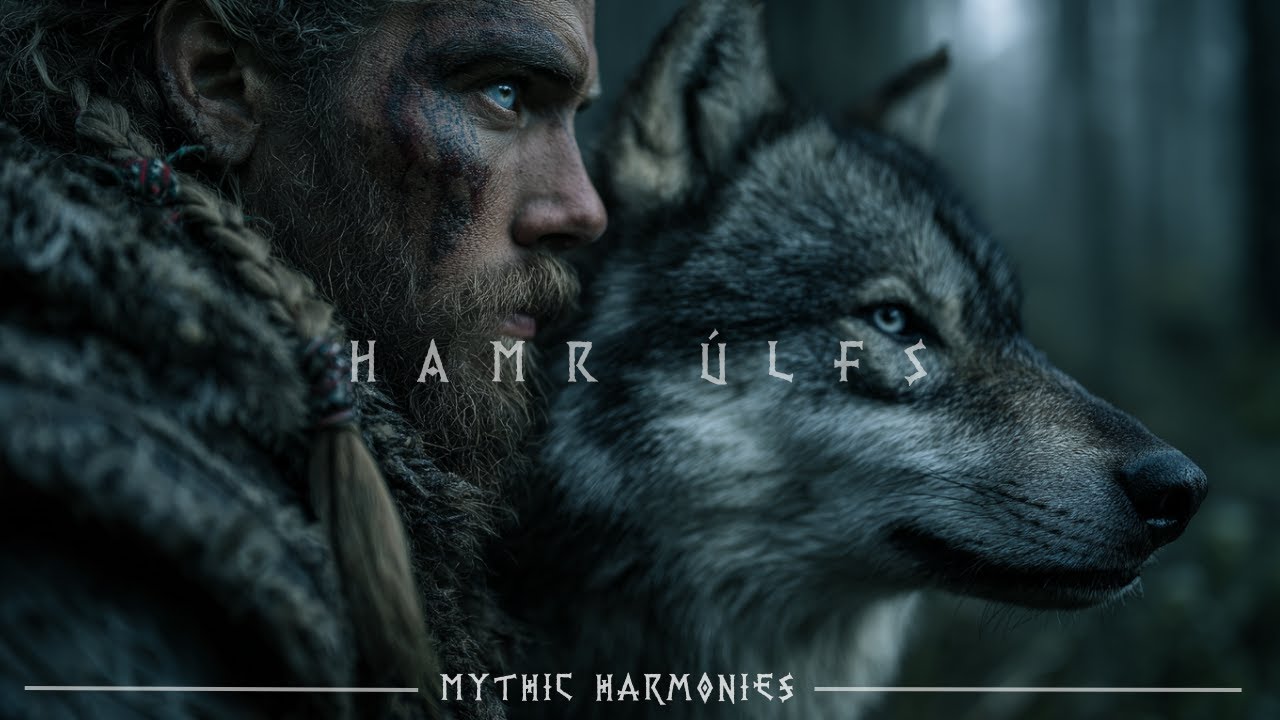
Hamr Úlfs (“Wolf Form”) is a 3:28 Mythic Harmonies song built around a modern warrior-transformation scene. Its narrator hears the wolf breathe, feels a second form awaken, abandons name and fear, and advances through fire, blood and forest shadow.
This page preserves the complete Hamr Úlfs lyrics and their released English rendering. The title uses real medieval-language vocabulary, and wolf-clad warriors do appear in Norse texts. The lyric’s initiation, literal inner transformation and “rite of blood,” however, are the song’s dramatic fiction—not a reconstructed Viking Age ceremony.
Hamr Úlfs at a Glance
- Title: Hamr Úlfs
- Artist: Mythic Harmonies
- Released language: stylized medieval-language text with an English artistic rendering
- Duration: 3:28 on YouTube; 3:27 on Spotify and Apple Music
- Central images: wolf breath, forest shadow, a waking form, discarded identity, fire and battle
- Source boundary: source-attested words and wolf-warrior imagery shaped into a modern original composition
What Does Hamr Úlfs Mean?
Hamr means “shape” or “form,” with a semantic range that can also touch an outer covering or assumed shape. The Viking Society’s Old Norse glossary gives the concise definition “shape, form.” Úlfs is the genitive singular of úlfr, “wolf.” The title therefore reads naturally as “form of a wolf” or, more compactly, “Wolf Form.”
“Wolf-skin” can work as a poetic association, especially beside the wolf-clad úlfheðnar, but it is not the only or automatically literal translation of hamr. Nor is Hamr Úlfs presented here as a surviving ritual formula. It is the modern song title chosen for a transformation narrative.
Hamr, Shape and Transformation in Norse Literature
Medieval Norse stories can speak of a person or supernatural being changing shape, travelling in another form or taking an animal appearance. In Ynglinga saga, for example, Snorri says Odin changed shapes while his body lay as if asleep or dead. That account is literary and was written centuries after the period it depicts.
The important distinction is between what a text imagines and what historical people demonstrably practised. Shape-changing episodes show that animal form was meaningful in medieval storytelling. They do not, by themselves, prove a standard initiation in which Viking warriors believed they physically became wolves.
Who Were the Úlfheðnar?
Úlfheðnar is commonly understood as “wolf-coats” or “wolf-skins.” The term appears beside berserkir in poetry associated with King Harald Fairhair. The evidence supports a remembered category of fearsome wolf-associated fighters; it does not give us a handbook describing their recruitment, exact equipment, tactics or theology.
The companion fiche Úlfheðnar owns the named wolf-warrior group and its song. Hamr Úlfs has a narrower role: the first-person moment in which the lyric’s narrator feels “the form” awaken. Keeping those intentions separate prevents two wolf songs from competing for the same exact search.
What Haraldskvæði Actually Says
In the surviving Haraldskvæði text, berserkers roar and úlfheðnar howl during battle. A later stanza calls them úlfheðnar as they bear bloodied shields and redden spears. This is vivid poetic testimony, not a neutral military report.
The poem does not say that every úlfheðinn felt no pain, used drugs, fought without armour, followed “pack tactics,” underwent the same trance or belonged to an organized secret cult. Those popular details combine different texts, modern theories and visual imagination. Hamr Úlfs can evoke animal ferocity without converting every later interpretation into fact.
Berserk Fury in Ynglinga Saga
Snorri’s Ynglinga saga describes Odin’s men as going without mail, becoming wild as dogs or wolves, biting their shields and seeming unharmed by fire or iron. The passage calls this berserksgangr, berserk fury. It is the clearest source behind several images now attached to berserkers.
But this account appears in a thirteenth-century saga about a legendary past. The Viking Society’s scholarly translation of Heimskringla I lets readers check both the passage and its context. It should not be silently recast as eyewitness proof that wolf-warriors were medically immune to weapons or fire.
Does the Song Describe a Historical Wolf Ritual?
No complete rite matching these verses is documented. “We walk the rite of blood,” the forgotten names, the absence of law and the awakening wolf form create a coherent initiation scene inside the song. They are not translated instructions from a saga, rune-stone or archaeological find.
Wolf imagery may have carried ideas of aggression, boundary-crossing, protection or affiliation in different contexts, and animal-associated warriors remain a serious field of interpretation. The responsible conclusion is narrower: the sources attest wolf-linked fighters and literary transformation motifs, while the exact ritual dramatized here is modern.
How the Song Stages the Change
The opening reduces transformation to two short actions: the wolf breathes; the form wakes. The first verse then removes social identity—name, shield and law—and replaces it with teeth, hide and blood. The refrain turns the change inward through fire in the chest and the disappearance of fear.
The final movement joins body and self: “Flesh and soul” and “No words remain.” That silence is the composition’s endpoint. The narrator does not become a zoological wolf on the page; human speech collapses as the repeated title takes over. The song’s power comes from that compression, not from claiming to reconstruct an ancient ceremony.
How Literal Is the English Rendering?
The English section is the released artistic rendering, not a word-for-word scholarly translation. The source-language verse is stylized and contains forms or constructions that do not always follow normalized prose grammar. Some English lines also choose the intended image over a literal equivalent.
For example, blóð er brag does not straightforwardly mean “blood is our bond,” and brotin fjǫldr is not a secure literal phrase for “the pack is broken.” The words are preserved because they are the published lyric. Labeling the English as artistic protects both the song and readers who arrive looking for language evidence.
Hamr Úlfs, Úlfheðnar and Berserker Songs
Several Mythic Harmonies tracks share wolves, rage and battle, so their pages need distinct centres. Hamr Úlfs owns “Wolf Form,” the waking hamr and the exact bilingual lyric below. Úlfheðnar owns the named wolf-coat warriors. Berserkir Rís owns the collective rise of berserkers, while Berserkr’s Call owns its separate call-to-battle narrative.
Fenrir songs belong to mythology and Ragnarök rather than human wolf-warrior identity. This division gives each track a precise answer, preserves useful internal paths and reduces cannibalization around broad phrases such as “Viking wolf song.”
Is Hamr Úlfs Historically Authentic?
Hamr Úlfs is a modern Mythic Harmonies composition, not a surviving Viking song. Its title, hamr, úlfr, úlfheðnar, howling fighters and saga descriptions of berserk fury all have source-based points of contact. The exact lyric, melody, wolf-spirit framing and transformation sequence are modern creations.
That distinction is not a weakness. It lets the track use medieval imagery openly while readers can see where the evidence ends. No claim of archaeological recovery, ritual reconstruction or flawless normalized grammar is needed.
Where to Listen to Hamr Úlfs
Watch the official 3:28 Hamr Úlfs video on YouTube. The matching Mythic Harmonies master runs 3:27 on Spotify and Apple Music. Artist and title match exactly, and the one-second platform difference is within the verified tolerance.
Hamr Úlfs Lyrics
The complete released words follow. The first block preserves the stylized source-language lyric; the second preserves its published English artistic rendering.
Stylized source-language lyric:
Úlfr andar. Hamr vaknar.
Í skugga skógar fæðist reið,
nöfn gleymd, en tennr eru leið.
Engi skjǫldr, engi lag,
bera vér feld, blóð er brag.Hamr úlfs! Í brjósti eldr!
Hamr úlfs! Brotin fjǫldr!
Hamr úlfs! Reið ok sár!
Hamr úlfs! Engi ótti þar!Ekki menn, né goða lið,
gangum vér í blóði sið.
Augun glóa, hjarta slær,
úlfar ganga, engi bær.Hamr úlfs! Í brjósti eldr!
Hamr úlfs! Brotin fjǫldr!
Hamr úlfs! Reið ok sár!
Hamr úlfs! Engi ótti þar!Hamr úlfs! Hold ok sál!
Hamr úlfs! Engi mál!
Hamr úlfs! Til falls vér!
Hamr úlfs! Rísum hér!Hamr… úlfs…
English artistic rendering:
The wolf breathes. The form awakens.
In the forest’s shadow, rage is born,
Names forgotten, teeth show the way.
No shield, no law,
We wear the hide, blood is our bond.Wolf form! Fire in the chest!
Wolf form! The pack is broken!
Wolf form! Fierce and scarred!
Wolf form! No fear remains!Not men, nor gods we follow,
We walk the rite of blood.
Eyes burning, hearts pounding,
Wolves advance, no settlement stands.Wolf form! Fire in the chest!
Wolf form! The pack is broken!
Wolf form! Fierce and scarred!
Wolf form! No fear remains!Wolf form! Flesh and soul!
Wolf form! No words remain!
Wolf form! We fall forward!
Wolf form! We rise here!Wolf… form…
What does Hamr Úlfs mean?
Hamr means ‘shape’ or ‘form,’ and úlfs is the genitive singular of úlfr, ‘wolf.’ The title therefore means ‘form of a wolf,’ rendered compactly as ‘Wolf Form.’ It is a modern song title, not a documented ritual formula.
Who were the úlfheðnar?
Úlfheðnar, commonly understood as ‘wolf-coats’ or ‘wolf-skins,’ are wolf-associated fighters named beside berserkers in Norse poetry. The sources do not provide a complete manual for their organization, equipment, initiation or beliefs.
Does Hamr Úlfs preserve a real Viking wolf ritual?
No complete historical rite matching the lyric is documented. Wolf-warriors and shape-changing imagery occur in medieval sources, but the forgotten names, blood rite and awakening inner wolf form are this modern song’s narrative.
Is the English text a literal translation of the Hamr Úlfs lyric?
No. It is the released artistic rendering. The source-language lyric is stylized and includes forms that do not always follow normalized prose grammar, so the page preserves both blocks without presenting the English as a scholarly word-for-word translation.
Where can I listen to Hamr Úlfs?
The official YouTube video runs 3:28. Spotify and Apple Music carry the matching Mythic Harmonies master at 3:27, with the same artist and exact title.
More from Epic War Battle
March with the War-Band
New Old Norse chants every month. Join the listeners who never miss a release.