
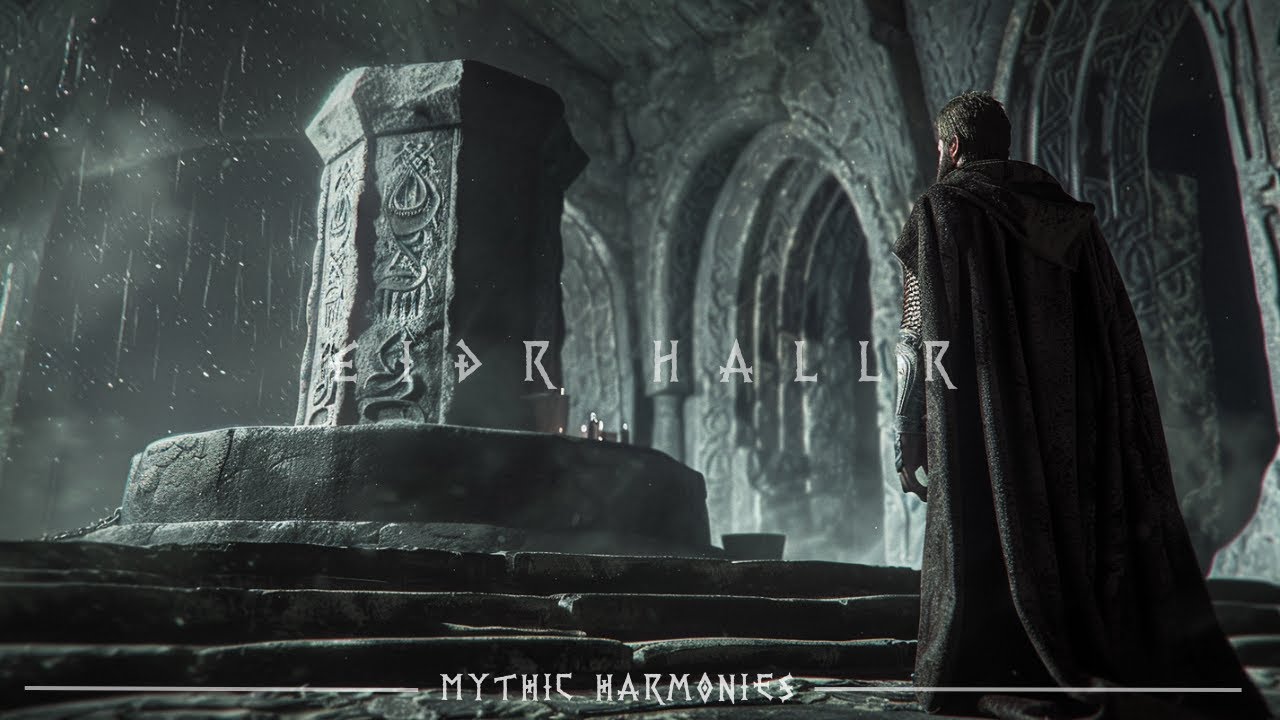
Eiðr Hǫll (“Hall of Oaths”) is a 4:30 Mythic Harmonies song in stylized Old Norse. A speaker enters an imagined ancient hall where stone, earth, family memory and the consequences of a sworn word appear to outlast the people who spoke it.
This page preserves the complete Eiðr Hǫll lyrics and English translation exactly as released. It treats the hall that remembers and the shadows that walk as modern poetic devices. Medieval sources attest serious oaths in varied narrative settings, but they do not establish one universal Viking “Hall of Oaths” or stones that literally retain speech.
Eiðr Hǫll at a Glance
- Site and video title: Eiðr Hǫll
- Released English title: Hall of Oaths
- Streaming title: Eiðhallr
- Artist: Mythic Harmonies
- Language: stylized Old Norse with an artistic English translation
- Duration: 4:30 on YouTube; 4:29 on Spotify and Apple Music
- Core theme: oath, memory, kinship and the cost of keeping faith
- Historical status: modern original composition
What Is Eiðr Hǫll About?
The opening begins with contact: a cold stone touches the speaker’s hand and wakes a memory. The hall is heavy and old, but the narrator’s own words fall uncertainly inside it. Silence then binds what the speaker holds dear before the refrain declares that the oath still lives there.
The second verse turns the oath into family memory. A father spoke, a mother listened, and the speaker carries both. Earth and stone become witnesses in the next couplet. Later, shadows, deeply carved names, betrayal and endurance enter the hall. The closing refrain moves from finding traces to placing the speaker’s path inside the oath: “My word is bound, never broken.”
What Does Eiðr Hǫll Mean?
Eiðr is “oath,” and hǫll is “hall.” The released subtitle Hall of Oaths gives the intended setting. As written, however, the title places two nominative nouns beside one another; it should be treated as a stylized artistic title rather than a secure normalized phrase meaning “the hall of oaths.”
The streaming services use the compact title Eiðhallr, while the video and this fiche use Eiðr Hǫll. Both names are preserved transparently. The title variation is not evidence for two different compositions: artist, linked release and the 4:29/4:30 duration agree.
Language and Translation Notes
The lyric combines recognizable vocabulary with uncertain or non-standard constructions. Examples include orð mín falla, ein ok varg, þögnin bindr það sem ek ann, Blóð mitt berr þau bæði tvá, þeir sem stóðu, lifa mjótt and Í eiðar hǫll stendr mín leið. They are preserved as performed, not silently regularized into a supposed manuscript stanza.
The English block is an artistic translation, not a line-by-line critical edition. Michael Barnes’s A New Introduction to Old Norse: Grammar supplies a normalized grammatical framework, while the University of Copenhagen’s Dictionary of Old Norse Prose documents attested vocabulary and senses.
Were Viking Oaths Always Sworn in a Hall?
No surviving source establishes that the most binding vows were universally made in great halls. Halls mattered as places of residence, feasting, lordship and assembly, but oath scenes vary with text and purpose. A late medieval saga cannot be turned into a single ritual manual for the entire Viking Age.
Gísla saga Súrssonar, for example, narrates an attempted foster-brother oath outdoors beneath raised turf supported by a rune-marked spear. One participant withdraws, and the bond fails. The episode is literary and preserved long after the period it portrays, but it is enough to disprove the page’s former claim that binding Norse vows were necessarily made inside a hall.
Stone, Earth and Carved Names
“The stone hears” and “the earth knows” personify the setting. They make the hall feel like a witness, but they do not document a Norse belief that masonry stored spoken oaths. The song’s stone is a modern narrative device.
Carved commemoration has a firmer historical parallel. The National Museum of Denmark’s guide to rune stones explains that many Viking-Age stones publicly named dead people, sponsors, kin, deeds and sometimes sad fates. That evidence concerns visible memorial inscriptions; it does not show that oaths were routinely carved or that stone itself judged oath-breakers.
Family Memory Is Not a Hereditary Oath
The father speaks, the mother listens and the narrator says that blood carries both. Within the song, this joins inheritance to longing. It does not prove a Norse legal rule that a child automatically inherited every parental oath or a religious doctrine that ancestral vows lived physically in blood.
The line “I step inside, but not alone” can be read as memory accompanying the speaker. The later shadows remain unnamed. This fiche does not turn them into ghosts, draugar, ancestors summoned by ritual or witnesses from a specific afterlife.
Betrayal, Judgment and Reputation
The lyric contrasts those who betrayed with those who stood. Its English translation says the betrayers vanished swiftly while the steadfast “remain, barely.” This is a severe moral contrast inside the composition, not a complete map of medieval law or social memory.
Oath disputes in sagas can produce feuds, compensation, outlawry, broken alliances or revenge, depending on the narrative. Being remembered or forgotten is likewise not an automatic sentence administered by an oath hall. The song condenses consequence into one image so that the final unbroken word feels costly.
How the 4:30 Recording Builds Weight
The refrain returns three times. Its first form finds traces where words become judgment; its second follows the earth-as-witness couplet; its final form changes the destination so the speaker’s path stands inside the hall. Repetition makes the oath feel accumulated rather than suddenly declared.
The official video confirms a 4:30 master. Spotify and Apple list the matching Mythic Harmonies release as Eiðhallr at 4:29, within the one-second acceptance rule. No complete personnel or instrument credits are presented here, so the fiche does not invent ritual drums, historical horns or a reconstructed Viking ensemble.
Related Oath Songs Without Cannibalization
Eiðr Hǫll owns the imagined hall, listening stone, parental memory and “words become judgment.” The Blood Oath owns the English brotherhood rite and its Gísla-saga comparison. Eiðr ok Blóð owns the oath-and-blood formula and its separate performed text.
Blóð ok Heiðr remains the Blood and Honor song about reputation, kin and a personal pledge. These pages can link to one another without competing for the same exact title, lyric or narrative intent.
Eiðr Hǫll Lyrics (Old Norse and English)
The first block is the released performed text; the second is the official artistic English translation. Both are reproduced unchanged.
Old Norse:
Kaldur steinn snertir hönd mína,
minni vaknar, hljótt ok fast.
Hǫllin stendur, þung ok forn,
orð mín falla, ein ok varg.Tunga þagnar, hugr minn man,
þögnin bindr það sem ek ann.Ek stíg inn, en eigi einn,
eiðr minn lifir hér enn.
Í eiðar hǫll finn ek spor,
þar sem orð verða dómr.Faðir mælti fornt eitt sinn,
móðir hlýddi, sagði ei.
Blóð mitt berr þau bæði tvá,
styrkr í eiði, þung í þrá.Steinninn heyrir, moldin veit,
allt sem sagt var, stendur rétt.Ek stíg inn, en eigi einn,
eiðr minn lifir hér enn.
Í eiðar hǫll finn ek spor,
þar sem orð verða dómr.Skuggar ganga með mér nú,
nöfn rist djúpt, ei í ryk.
Þeir sem sviku, hurfu fljótt,
þeir sem stóðu, lifa mjótt.Ek stíg inn, en eigi einn,
eiðr minn lifir hér enn.
Í eiðar hǫll stendr mín leið,
orð mitt bundið, rofnar ei.Steinninn man… eiðr minn stendr…
English translation:
Cold stone touches my hand,
Memory awakens, silent and firm.
The hall stands, heavy and ancient,
My words fall, alone and wary.The tongue falls silent, my mind remembers,
Silence binds what I hold dear.I step inside, but not alone,
My oath still lives here.
In the Hall of Oaths I find traces,
Where words become judgment.My father once spoke ancient words,
My mother listened, did not speak.
My blood carries them both,
Strong in oath, heavy in longing.The stone hears, the earth knows,
All that was said still stands true.I step inside, but not alone,
My oath still lives here.
In the Hall of Oaths I find traces,
Where words become judgment.Shadows walk with me now,
Names carved deep, not into dust.
Those who betrayed vanished swiftly,
Those who stood remain, barely.I step inside, but not alone,
My oath still lives here.
In the Hall of Oaths my path stands,
My word is bound, never broken.The stone remembers… My oath stands…
Listen to Eiðr Hǫll
Watch the official 4:30 Eiðr Hǫll video. The matching 4:29 Mythic Harmonies master is distributed as Eiðhallr on Spotify and Apple Music.
Sources and Further Reading
- Michael Barnes, A New Introduction to Old Norse: Grammar, Viking Society for Northern Research.
- Dictionary of Old Norse Prose, University of Copenhagen.
- Gísla saga Súrssonar, for the failed foster-brother oath scene beneath raised turf; used as a later literary witness, not a universal ritual manual.
- National Museum of Denmark: Rune stones, for public commemoration and what inscriptions actually record.
Questions About Eiðr Hǫll
What does Eiðr Hǫll mean?
Eiðr means “oath” and hǫll means “hall.” “Hall of Oaths” is the released artistic subtitle, but the two-noun title should not be presented as a secure normalized medieval phrase.
Is Eiðr Hǫll an authentic Viking Age oath song?
No. It is a modern original Mythic Harmonies composition in stylized Old Norse. No medieval manuscript or inscription preserves this lyric, translation or melody.
Were Viking oaths always sworn in a hall?
No source establishes a universal hall-only rule. Gísla saga, a later literary witness, places an attempted foster-brother oath outdoors beneath raised turf, showing why one scene cannot define all Norse oath practice.
Did Norse people believe stone remembered spoken oaths?
The song personifies stone and earth as witnesses. Rune stones document visible names, kin and commemoration, but they do not prove that masonry literally stored speech or judged oath-breakers.
Where can I listen to Eiðr Hǫll?
The official video runs 4:30. The matching 4:29 Mythic Harmonies master is titled Eiðhallr on Spotify and Apple Music, within the one-second matching rule.
More from Funeral & Ritual
March with the War-Band
New Old Norse chants every month. Join the listeners who never miss a release.