
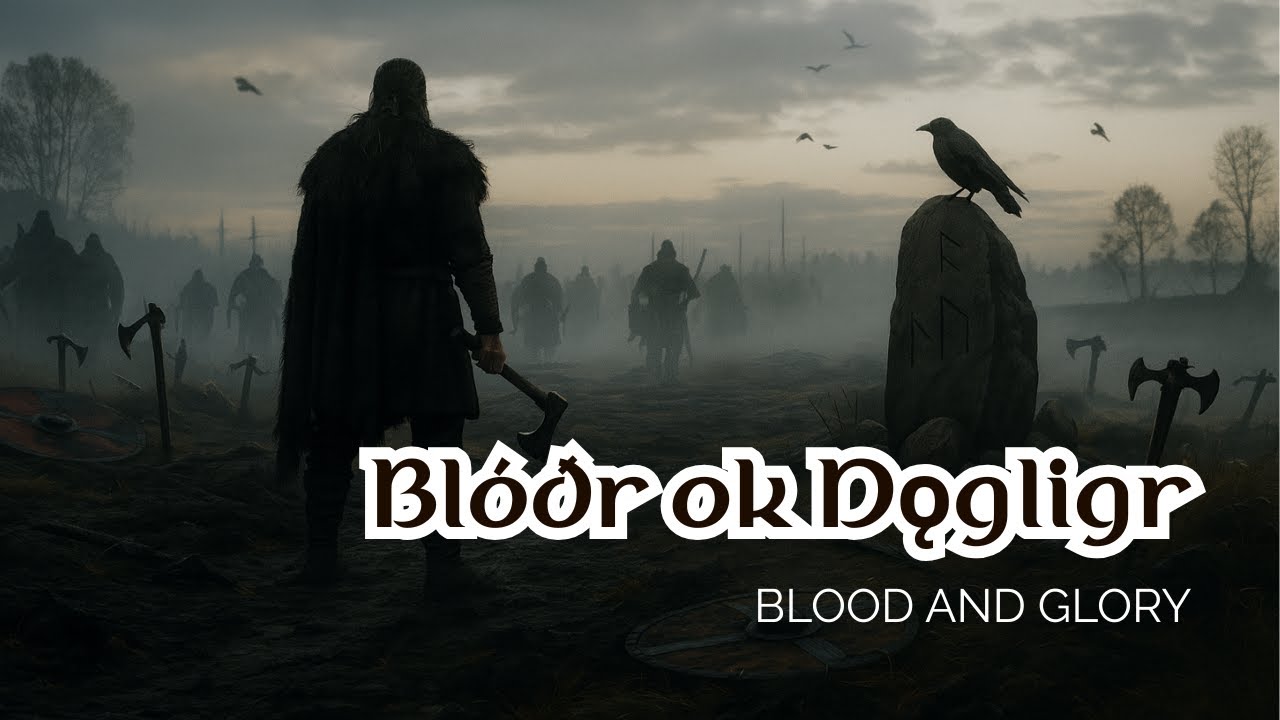
Blóðr ok Dǫgligr (“Blood and Glory”) is a 3:28 Mythic Harmonies battle song built around a bereaved fighter’s decision to avenge his brother. The official video and the matching 3:27 streaming master place Freyja, a “berserker’s heart,” a blood-marked shield and the speaker’s children inside one modern Norse-inspired drama.
This music fiche identifies that recording, follows its story and explains the historical allusions behind it before preserving the complete published text and English adaptation. The song is a modern composition: its narrator’s vows are part of the character’s voice, not a recovered Viking code or an ancient Freyja ritual.
Blóðr ok Dǫgligr at a Glance
- Released title: Blóðr ok Dǫgligr (“Blood and Glory”)
- Artist: Mythic Harmonies
- Official video runtime: 3:28
- Verified streaming master: 3:27 on Spotify and Apple Music
- Language: stylized Old Norse with a published English artistic adaptation
- Song focus: grief becomes vengeance after the narrator’s brother is killed
- Mythic focus: Freyja as a recipient of battle-slain warriors, not merely a love goddess
What Does Blóðr ok Dǫgligr Mean?
“Blood and Glory” is the song’s published English rendering. The first element visibly evokes Old Norse blóð, “blood,” although the released spelling Blóðr is not the usual dictionary headword. The second element, Dǫgligr, should not be presented as a transparent, securely normalized one-word equivalent of English “glory.”
The responsible reading is therefore the artistic one supplied with the release, while preserving the exact title under which the track appears. This is a stylized song title rather than a phrase quoted from a medieval manuscript. For a separately released Mythic Harmonies track centered on “blood and honor,” see Blóð ok Heiðr; the two recordings are not alternate versions of one song.
What Story Does the Song Tell?
The first verse establishes the loss immediately: the speaker’s brother has taken a sword to the chest. Wet ground, inward fire and thunder turn bereavement into movement. “Now I rise” is not a general history lesson; it is the point at which this particular narrator chooses revenge and invokes Freyja whatever the cost.
The second passage closes the character’s world down to sword, smoke, blood and judgment. The refrain then binds three ideas together: killing for Freyja, entering combat with a “berserker’s heart,” and imagining honor as something that survives death. In the final verse, the children become the intended witnesses. The speaker wants them to remember strength rather than weakness, so vengeance is also framed as a contested legacy.
That narrative sequence distinguishes the track from the broader battle pieces in the catalogue. Blóðr ok Dǫgligr owns the brother’s death, the vow to Freyja and the appeal to the speaker’s children. It does not retell the allocation of the slain in full, and it is not a general biography of Freyja or a documentary reconstruction of berserkers.
Why Does the Singer Invoke Freyja?
The invocation has a genuine medieval point of contact. In stanza 14 of Grímnismál, Fólkvangr belongs to Freyja; the poem says that she chooses half of those slain in battle and that Odin has the other half. Snorri’s prose later says that wherever Freyja rides to battle, she receives half of the slain. These witnesses support a martial afterlife association.
They do not establish the song’s exact vow, words or ceremony, and Grímnismál does not explicitly say that Freyja makes the first choice. The track turns a source-based association into a new first-person prayer of vengeance. The distinction between Freyja’s Fólkvangr and Odin’s Valhalla is examined in the dedicated guide to Valhalla and Fólkvangr; the wider deity profile belongs to Freyja.
What Does the “Berserker’s Heart” Mean Here?
“With a berserker’s heart” is the refrain’s image for total commitment to combat. It belongs first to the song’s dramatic vocabulary. Medieval evidence does attest berserkir: skaldic poetry and later prose associate the name with exceptional fighters, while Snorri describes Odin’s men fighting without armor and behaving with extreme ferocity.
That evidence does not prove a universal “holy rage” in which every berserker ignored pain, nor does this recording document a historical induction rite or drug. The phrase should be heard as characterization, not diagnosis. The focused histories and debates belong on the separate Berserkir Rís and Berserkr’s Call fiches.
Vengeance, Honor and the Narrator’s Voice
The chorus says that death comes while honor lives, and the closing verse opposes vengeance and inherited custom to beauty and peace. These are forceful claims made by a fictional speaker at the edge of battle. Treating them as the single ethical system of all Viking Age Scandinavians would flatten a diverse body of law, poetry, family obligation and literary storytelling.
The most useful interpretation is internal to the song. The narrator cannot reverse his brother’s death, so he imagines reputation, children and tradition as forms of survival. The English adaptation intensifies that psychology through “whatever the cost,” “honor lives” and “I am not weak.” It is a modern tragic voice, not a neutral endorsement of revenge.
How the Battlefield Imagery Works
The text repeatedly pairs water and fire: wet earth is answered by fire in the chest, while the sword “swims” through smoke. Blood appears as both wound and anointing. The shield is not described as an archaeological object or magical artifact; in the refrain it gives the frightened speaker strength. Thunder begins inside the heart, turning weather into emotion.
Those repeated images create the track’s identity more securely than unsupported claims about exact instruments or production techniques. Without published performance credits, it would be speculation to name a particular drum, historical vocal method or reconstructed shield-wall sound. What can be verified is the recording, its runtime, its words and their narrative pattern.
Is Blóðr ok Dǫgligr an Authentic Viking Age Song?
No. Blóðr ok Dǫgligr is an original modern Mythic Harmonies composition. No Viking Age inscription or medieval manuscript preserves this text, translation, melody, chorus or revenge scene. Its Freyja association has a medieval basis, but the brother, children, repeated vow and full battlefield narrative belong to the contemporary song.
The source-language block is best described as stylized Old Norse. It contains recognizable vocabulary alongside non-normalized or uncertain forms, and it is preserved below exactly as released rather than silently rewritten into a scholarly edition. The English block is the published artistic adaptation, not a literal line-by-line gloss.
Source Notes
- Grímnismál 14, edited and translated by Edward Pettit: the principal poetic witness for Freyja choosing half of the battle-slain and Odin receiving half.
- Snorri Sturluson’s Edda: Prologue and Gylfaginning, Viking Society for Northern Research: a critical edition for Snorri’s prose mythology, including Freyja’s relation to the slain.
- Swedish History Museum, “Freyja – goddess of fertility and war”: museum context for Freyja, Fólkvangr and her share of fallen warriors.
- Snorri Sturluson’s Heimskringla I, translated by Alison Finlay and Anthony Faulkes: later prose context for Snorri’s famous description of berserkers; it is not evidence for this song’s invented vow.
- Dictionary of Old Norse Prose, University of Copenhagen: lexical reference used to avoid presenting the released title as a normalized medieval quotation.
Where to Listen to Blóðr ok Dǫgligr
Watch the official 3:28 video at the top of this fiche. The same Mythic Harmonies recording is available as a 3:27 master on Spotify and Apple Music. The one-second difference is within the catalogue’s matching rule and the artist and title agree.
Lyrics & English Adaptation
The two blocks below preserve the published transcription and artistic English rendering exactly. They are presented as the words of this modern song, not as a medieval text or a scholarly normalized translation.
Original Text (Stylized Old Norse)
Dagr rís meðr þrumum í hjarta Blaut jǫrð, en eldr í brjósti Bróðr minn hlaut sverð við brjóst Nú ek rís — fyrir Freyju, viðr kost
Sverð minn sjóar í dauðans reyk Andlit mín, smyrsl af blóði veik Ek eigi friðr, eigi mjǫk orð Bara dómr, ok barátta á jǫrð
Drepa fyrir Freyju, viðr hjarta berserkr Meðr kraftr goða, brenna sem eldr Dauði kemr, en æra lifir Síðr ek hræðask – skjǫldr minn gefr styrkr
Bǫrn mín sjái, eigi ek veikr Ek ber dróttin, meðan bein mín breik Ek syng ei fyrir fríð, né friðr Heldr ek syng, fyrir hefnd ok siðr
Drepa fyrir Freyju, viðr hjarta berserkr Meðr kraftr goða, brenna sem eldr Dauði kemr, en æra lifir Síðr ek hræðask – skjǫldr minn gefr styrkr
English Artistic Adaptation
Day rises with thunder in the heart Wet earth, yet fire in the chest My brother received a sword to the breast Now I rise — for Freyja, whatever the cost
My sword swims in the smoke of death My face, anointed with the salve of weak blood I hold no peace, nor many words Only judgment, and struggle on the earth
Kill for Freyja, with a berserker’s heart With the gods’ strength, burning like flame Death comes, yet honor lives No longer do I fear – my shield gives strength
May my children see, I am not weak I carry the lord, while my bones creak I do not sing for beauty, nor peace But I sing for vengeance and tradition
Kill for Freyja, with a berserker’s heart With the gods’ strength, burning like flame Death comes, yet honor lives No longer do I fear – my shield gives strength
What does Blóðr ok Dǫgligr mean?
“Blood and Glory” is the track’s published English rendering. The released spelling is stylized: blóð is the standard word for blood, while Dǫgligr should not be presented as a secure normalized one-word equivalent of glory.
What story does Blóðr ok Dǫgligr tell?
A fighter sees his brother killed, rises for revenge and invokes Freyja. The chorus joins a berserker’s heart with death and lasting honor, while the final verse asks the speaker’s children to remember his strength.
Why does the song invoke Freyja?
Grímnismál 14 says Freyja chooses half of those slain in battle while Odin has the other half. That source supports her martial afterlife association, but the song’s exact vow, brother and revenge scene are modern creations.
Is Blóðr ok Dǫgligr an authentic Viking Age song?
No. It is an original modern Mythic Harmonies composition in stylized Old Norse. No medieval manuscript or inscription preserves this lyric, English adaptation, melody or Freyja invocation as an ancient song.
Where can I listen to Blóðr ok Dǫgligr?
The official video runs 3:28 on YouTube. The matching Mythic Harmonies master is available under the exact title on Spotify and Apple Music at 3:27, within the one-second duration rule.
More from Epic War Battle
March with the War-Band
New Old Norse chants every month. Join the listeners who never miss a release.