
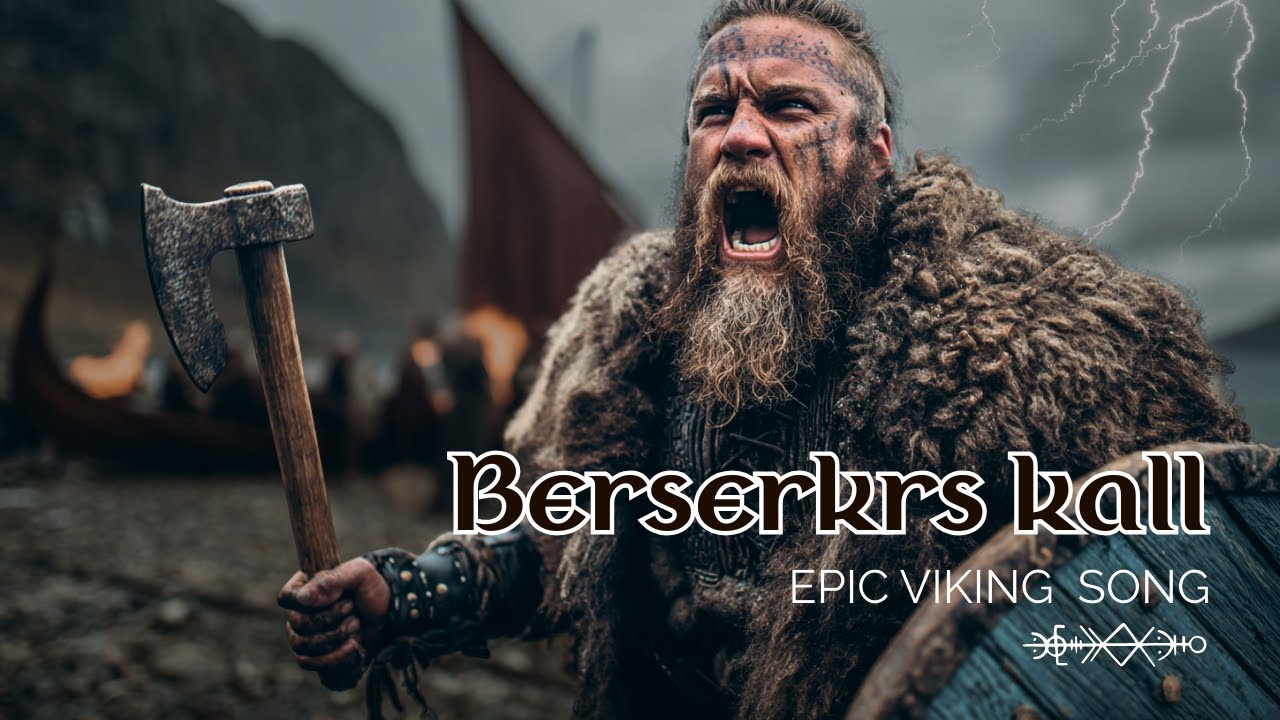
Berserkr’s Call is an original Old Norse-inspired war song by Mythic Harmonies. A low marching pulse gathers into massed voices, horn-like accents and a final invocation of Odin, Thor and Freyr. Its opening words salute the famous “My Mother Told Me” stanza in Egils saga; everything that follows is a modern composition.
This is the crucial distinction: the saga preserves an eight-line stanza about a ship, oars, voyaging with vikings and killing opponents. It does not preserve the complete lyric printed below, a berserker ceremony, this melody or a three-god battle prayer. The medieval episode supplies a sharp literary point of departure; the track builds a new cinematic story around it.
What Is Berserkr’s Call?
Berserkr’s Call is the English release title; the catalogue card also uses Berserkrs kall, “the berserker’s call.” Unlike Berserkir Rís, which centers on the collective rise of animal-warriors, this song begins with a young poet’s imagined future at sea and expands from personal ambition into a communal battle refrain.
The word berserkr itself is historically attested, but its familiar “bear-shirt” explanation is not the only possible etymology; “bare-shirted” has also been defended. Early skaldic verse associates berserkir with royal warfare, while later prose develops the famous images of fury, shield-biting and extraordinary strength. The track uses that later imaginative vocabulary without presenting it as a literal ritual reconstruction.
Track Facts and Official Streaming Links
- Artist: Mythic Harmonies
- Official streaming title: Call of the Berserker
- Album: Shadows over Midgard (2025)
- Language: stylized Old Norse-inspired lyric with an interpretive English translation
- Duration: 4:15 on the official video; 4:14 on Spotify and Apple Music (one-second difference)
Listen to the verified recording on Spotify or Apple Music. The title matches the song’s English name and the durations agree within the required one-second tolerance.
“My Mother Told Me”: What Egils saga Actually Says
The source scene occurs in chapter 40 of Egils saga Skalla-Grímssonar. During a ball game, the young Egill quarrels with an older boy named Grímr and kills him with an axe. Back at home, his father shows little approval. His mother Bera instead says that Egill has the makings of a viking and that a warship should be obtained for him when he is old enough. The saga then introduces the stanza beginning Þat mælti mín móðir, “My mother said this.”
The Viking Society’s scholarly edition of Egils saga prints the prose and stanza together. In the verse, the speaker says that a ship and good oars should be bought for him, that he will go away with vikings, stand at the stem, steer a costly cargo ship to harbour, and kill one man after another.
That context is darker than a generic prophecy of exploration. The stanza follows a child’s killing within a thirteenth-century saga narrative, and Bera’s response frames violence, seafaring and social ambition together. It is evidence for how the saga constructs Egill’s precocious persona—not a transcript recorded during his childhood and not proof that Viking parents generally trained children for slaughter.
The Medieval Stanza and the Modern Song Are Not the Same Text
The song opens Móðir mín mælti mér, a recognizable salute to the saga, but it immediately diverges. Its sea-fjord, guiding wind, Valhalla, wolves, ravens, repeated calls to wind and sea, brothers dying together, and final invocation of three gods do not occur in Egill’s eight-line stanza.
The difference is intentional. Mythic Harmonies borrows a compact premise—a mother imagines a maritime warrior future—and writes a new refrain around motion, kinship and mortality. The English text below translates the intended sense of these released modern lines. It should not be substituted for a translation of Þat mælti mín móðir in a classroom or historical quotation.
The Skaldic Project’s Egill corpus, edited by Margaret Clunies Ross, provides the specialist route into the stanza, its manuscript readings and its place among the verses attributed to Egill. The attribution belongs to the saga tradition; as with many saga verses, composition date and historical authorship require scholarly caution.
Odin, Thor and Freyr: Source, Context and Limits
The song closes by naming Odin, Thor and Freyr. There is a medieval source for seeing those three names together: the eleventh-century cleric Adam of Bremen describes images of Thor, Wodan and Fricco at Gamla Uppsala, with Thor in the central seat. Fricco is commonly interpreted as Freyr. Adam assigns different functions to the figures and associates Wodan especially with war.
That account does not establish a standardized “divine triad” invoked by Viking armies, nor does it say that calling all three guaranteed total favour in battle. Adam wrote at a distance within a Christian missionary history. As the study “Stealing his Thunder” in Saga-Book XLI explains, the broad presence of the three figures may be tenable, but details of the Uppsala description remain contested and may reflect classical and rhetorical models.
In this track, the three names operate musically: Odin sharpens the warlike frame, Thor lands with the hammer image, and Freyr widens the final appeal toward continuity and prosperity. “My kin lives, never dies” is a modern chorus claim, not a documented promise made by Freyr to warriors.
How the Arrangement Builds the Call
The arrangement advances in layers. A repetitive low pulse supplies forward motion; the voice begins as narrator, then the refrain answers with broader, more collective force. Horn-like timbres mark transitions, but calling any one of them “the Gjallarhorn” would turn a mythic object into an unsupported instrument label.
Repetition is the central device. “Hear the wind, hear the sea” moves the listener through landscape before “hear the gods” changes the scale. The last names are not an archaeological reenactment of call-and-response practice. They are contemporary songwriting choices that make the ending feel communal and immediate.
For a sourced guide to the warrior category behind the title, read the companion fiche Berserkir Rís. For the preserved wake-up poem behind another battle composition, continue with Bjarkamál. All bilingual entries are indexed in the Songbook of the North.
Berserkr’s Call Lyrics and English Translation
These are the released Mythic Harmonies words: an original stylized Old Norse-inspired lyric and its interpretive English translation. Only the opening idea pays homage to the saga stanza.
Original Lyrics (Old Norse)
Móðir mín mælti mér, Sigla mun ek sævarr fjǫrð. Vindr mun leiða skip mitt fram, Til Valhǫllar, til dýrðar land.
Sverð í hendi, hjarta brenn, Úlfar grenja, stríð hefst enn. Hrafnar vaka yfir blóð, Óðinn kallar, drepr minn móð.
Heyrðu, vindr, heyrðu, sjór, Berserkr kallar, hamarr slær. Heyrðu, fjall, heyrðu, goð, Ætt mín lifir, aldri deyr.
Móðir mín mælti mér, Sigla mun ek í stormi sér. Brœðr mínir við lið mér stendr, Deyjum saman, dýrð ei endr.
Heyrðu, vindr, heyrðu, sjór, Berserkr kallar, hamarr slær. Heyrðu, fjall, heyrðu, goð, Ætt mín lifir, aldri deyr.
Horn gjallar, skip siglir fram, Eldrs logar, vígr klæðr gamn. Hrafnar fljúga, blóðr fellr, Ævi mín endr, Valhǫll kveldr.
Heyrðu, vindr, heyrðu, sjór, Berserkr kallar, hamarr slær. Heyrðu, fjall, heyrðu, goð, Ætt mín lifir, aldri deyr.
Heyrðu, himinn, eldr ok snær, Heyrðu, dauði, eigi fær. Viðr váru menn, eigi fellr, Viðr stríð lifum, aldri ellr.
Óðinn! Þórr! Freyr! Óðinn! Þórr! Freyr! Við stríð lifum, við stríð deyjum!
English Translation
My mother told me, I will sail the sea’s fjord. The wind will guide my ship ahead, To Valhalla, to the land of glory.
Sword in hand, heart aflame, Wolves are howling, war begins again. Ravens watch above the blood, Odin calls, driving my spirit.
Hear the wind, hear the sea, The berserker calls, the hammer strikes. Hear the mountain, hear the gods, My kin lives, never dies.
My mother told me, I will sail into the storm itself. My brothers stand by my side, We die together, glory never ends.
Hear the wind, hear the sea, The berserker calls, the hammer strikes. Hear the mountain, hear the gods, My kin lives, never dies.
Horns sound, the ship sails on, Flames are rising, warriors dressed for war. Ravens fly, blood falls, My life ends, Valhalla awaits.
Hear the wind, hear the sea, The berserker calls, the hammer strikes. Hear the mountain, hear the gods, My kin lives, never dies.
Hear the sky, the fire and the snow, Hear death, it does not prevail. We were men, we do not fall, In war we live, never grow old.
Odin! Thor! Freyr! In war we live, in war we die!
Is Berserkr’s Call the same song as My Mother Told Me?
The song pays homage to the saga stanza commonly known in English as My Mother Told Me, but only its opening premise is borrowed. The remaining verses, refrain and divine invocation are original Mythic Harmonies writing.
Did Egill compose the My Mother Told Me stanza after killing a boy?
In chapter 40 of Egils saga, the young Egill kills Grímr after a ball-game quarrel. His mother calls him promising viking material, and the saga then introduces the stanza. This is a medieval literary narrative, not an eyewitness transcript.
Are the Old Norse lyrics the original Egill poem?
No. The medieval stanza is eight lines long. The lyrics here use a related opening idea, then develop new imagery about Valhalla, wolves, ravens, kinship and three gods.
Were Odin, Thor and Freyr invoked together before battle?
Adam of Bremen places images of Thor, Wodan and Fricco together at Uppsala, but he does not document a standard three-god battlefield prayer. The invocation in this song is modern.
Where can I stream Call of the Berserker?
The verified 4:14 recording is on Spotify and Apple Music under the title Call of the Berserker, on the album Shadows over Midgard. The official video runs 4:15.
More from Epic War Battle
March with the War-Band
New Old Norse chants every month. Join the listeners who never miss a release.