
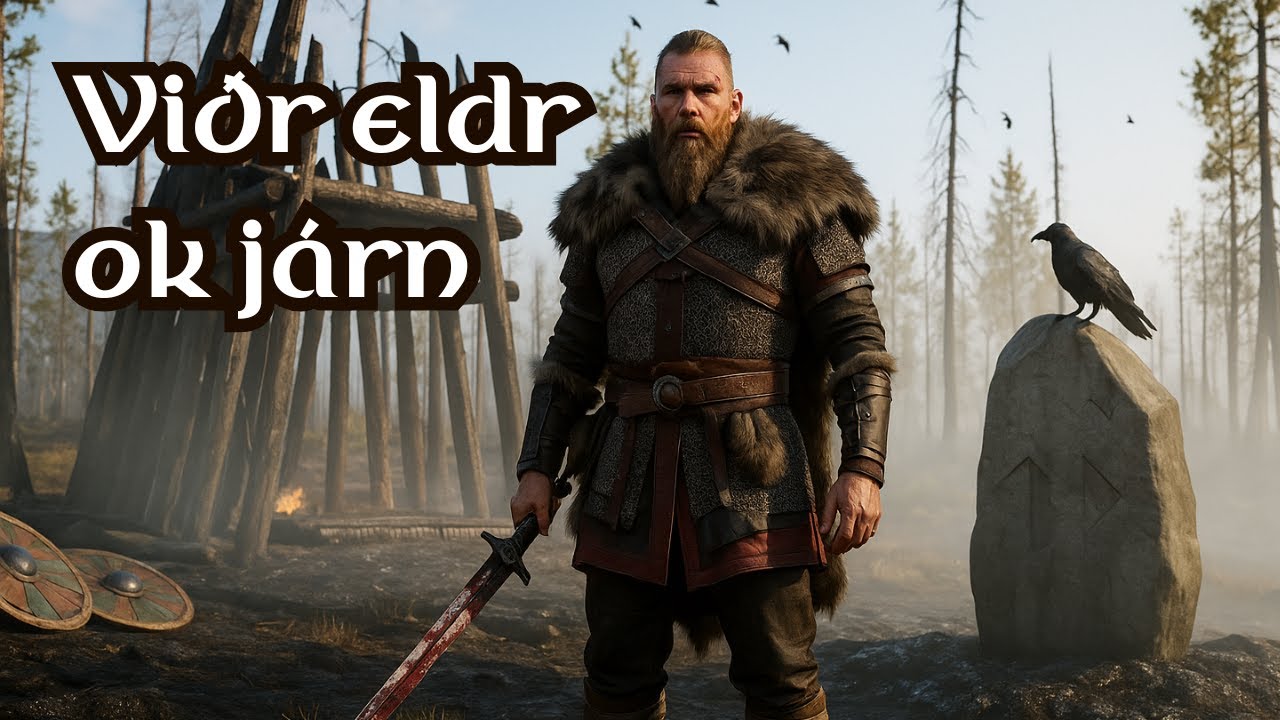
What Is Viðr eldr ok járn?
Viðr eldr ok járn (“Through Fire and Iron”) is a 4:16 Mythic Harmonies battle song performed in stylized Old Norse. Its unnamed speaker walks into fire, iron and war with a shield in hand, imagines Valhalla, calls himself fated yet free and ends by standing “like a mountain” while the world breaks.
- Artist: Mythic Harmonies
- Recording: official 4:16 YouTube master
- Language: modern Old Norse-inspired lyric with a published English rendering
- Point of view: first-person warrior declaration
- Core contrast: mortality versus chosen defiance—“fated, yet free”
- Historical status: a modern composition, not a surviving Viking Age battle hymn
This fiche is about that exact recording: title, story, recurring images, complete words and verified listening links. Historical weapons and medieval poetry provide limits and context; they do not turn the track into a reconstruction.
What Does Viðr eldr ok járn Mean?
The released English title is “Through Fire and Iron.” Eldr is “fire,” ok is “and,” and járn is “iron.” The first word needs more caution. Old Norse við(r) can work in meanings such as against, toward or with depending on construction; it is not a simple word-for-word equivalent of English “through” in every context.
The title and the repeated line “Viðr eldr… Viðr járn…” should therefore be read as the song’s compact artistic phrase. “Through Fire and Iron” captures the intended ordeal, but it is freer than a normalized literal translation.
The Song’s Story: Fated, Yet Free
The first stanza drops the listener into a personal hour of judgment. The gods watch, a shield is held, the heart becomes stone and the speaker fights among blood. No enemy, battlefield or historical campaign is named. The scene is intentionally elemental: fire, iron, shadow, shield and fate.
The middle stanza gives the song its philosophical tension. The warrior rejects shame, pictures himself singing in Valhalla and stands beside a brother. Then comes the hinge: “Feigr, en frjáls”—rendered “Fated, yet free.” The character cannot erase death, but claims freedom in how he meets it. That is the dramatic logic of this composition, not a universal doctrine attributed to every Viking.
The final stanza turns the sword into personal faith, places song against death and gives the speaker biting teeth and a mountain stance. The coda strips the declaration to four images: fire, iron and honour separated by pauses. The track’s protagonist survives in sound even though the lyric never promises physical survival.
Fire, Iron, Shield and Sword in the Track
Iron is not merely a synonym for “Viking steel.” Viking Age sword blades, spearheads, axes, shield bosses and many tools were iron-based objects made through skilled production; high-quality weapons could be prestigious and expensive. The National Museum of Denmark describes swords as status-laden objects that could be inherited, gifted, imported or deposited.
The lyric uses those real materials as emotional shorthand. Its “heart of stone” is not an attested warrior training formula, and “my sword is my faith” is modern poetic personification—not proof that every fighter treated a weapon as a religion or living companion. Likewise, the metallic feel of the arrangement can evoke clashing arms, but it does not reproduce a documented shield-wall soundscape.
Teeth, Fury and the Mountain Image
The line “my teeth bite on” may remind modern listeners of Snorri’s later description of berserkir biting shield rims, but this song neither uses the word berserkr nor describes a shield being bitten. Calling its vocal intensity berserkergang that “burns away fear” would add a ritual mechanism the lyrics do not contain.
“I stand like a mountain” is clearer: it is the speaker’s simile for remaining fixed while the world breaks. It can express resilience without being promoted to “the ultimate stoicism of the Viking warrior.” The mountain belongs to this character’s last stand, not to a historically documented Scandinavian philosophy.
Valhalla and the Gods Who Watch
The first stanza says the gods see the speaker’s allotted time, while the second imagines singing in Valhalla. The song never names Odin, a valkyrie or the manner by which the warrior reaches the hall. Valhalla is his hoped-for horizon, not a guarantee issued by the watching gods.
Medieval material is more complicated than “all honourable warriors go to Valhalla.” Grímnismál 14 gives Freyja half of the battle-slain and Odin the other half, and Norse texts preserve other destinations. The full question belongs to the evidence-led guide to Valhalla and Fólkvangr; this fiche records what one invented speaker believes.
Language Note: An Artistic Rendering, Not a Critical Text
The two blocks below are preserved exactly as released. The left-hand text uses Old Norse vocabulary and letters but is not consistently normalized. Examples include Viðr eldr ek gengi, hjarta af stein, við vegum, meðr dómr, nafnið míns þjóma, meðr bróðr við lið, dauð tíð, Sverð mitt minn trú, örlog and dauði kvellr.
The English text also expands meanings: the published Norse wording does not literally supply every word in “judgment unknown,” “my brother’s rite,” “death’s tide” or “while the world breaks in flame.” It is the official artistic adaptation, not a word-for-word scholarly translation. The song remains valuable as a modern composition without being mislabeled as a medieval source.
Viðr eldr ok járn Lyrics and English Translation
Published Old Norse-inspired lyrics:
Viðr eldr ek gengi, viðr járn ok stríð Skuggar falla, goðin sjá mína tíð Skjǫldr í hendi, hjarta af stein Í blóði við vegum, meðr dómr sem mein
Ek dey eigi í skǫmm, heldr í ljóma Í Valhǫll syng ek nafnið míns þjóma Feigr, en frjáls — meðr bróðr við lið Viðr eldr ok járn, vér gleypum dauð tíð
Sverð mitt minn trú, í regni sem fellr Ek syng meðr örlog, þó dauði kvellr Tennr mínar bíta, eigi í last Ek stend sem fjall, meðan heimr brestr fast
Viðr eldr… Viðr járn… Ok æra…
Published English rendering:
Through fire I walk, through iron and war Shadows fall, the gods witness my hour Shield in hand, a heart of stone In blood we fight, with judgment unknown
I die not in shame, but in light In Valhalla I sing my brother’s rite Fated, yet free — side by side Through fire and iron, we devour death’s tide
My sword is my faith, in the falling rain I sing with fate, though death may reign My teeth bite on, not with blame I stand like a mountain while the world breaks in flame
Through fire… Through iron… And with honor…
Listen to the Exact Recording
Watch the exact 4:16 Viðr eldr ok járn video on YouTube. Authenticated catalogue searches found no Mythic Harmonies track matching both this title and duration on Spotify or Apple Music. This fiche therefore keeps the official Spotify artist page and Apple Music artist page rather than attaching another fire or battle song.
Related Songs Without Overlap
This page owns the 4:16 master, the phrase “fated, yet free,” the mountain stance and the title Through Fire and Iron. Sverð ok Eldr keeps “Sword and Fire,” its beach-battle refrain and its own 3:14 master. Blóð ok Eldr keeps “Blood and Fire.” Runes of Fire belongs to a separate English-language rune-and-forge song. Their shared materials do not make the recordings interchangeable.
Sources and Further Reading
- Michael Barnes, A New Introduction to Old Norse, Part I: Grammar, used to check forms, cases and agreements.
- National Museum of Denmark, “Viking swords”, for material, construction, prestige, inheritance, gifts and deposits.
- National Museum of Denmark, “Viking shields”, for shield construction and archaeological limits.
- Edward Pettit (trans.), The Poetic Edda, especially Grímnismál for the division of the battle-slain.
What is Viðr eldr ok járn about?
An unnamed warrior walks into fire, iron and war, imagines Valhalla, calls himself “fated, yet free” and stands like a mountain while the world breaks. It is a first-person defiance song, not the account of a named battle.
What does Viðr eldr ok járn mean?
The released title is “Through Fire and Iron.” Eldr means fire, ok means and, and járn means iron. Við(r) has meanings such as against, toward or with depending on construction, so the English title is an artistic rendering rather than a simple literal gloss.
Is this an authentic Viking Age battle hymn?
No. It is a modern Mythic Harmonies composition in stylized Old Norse-inspired language. Its weapons and Valhalla imagery have historical contexts, but the words, melody and warrior scene are new.
Are the lyrics normalized Old Norse?
Not consistently. The published text contains recognizable vocabulary alongside non-normalized cases, agreements and freer English expansions. Both lyric blocks are preserved exactly, with the English identified as the official artistic adaptation.
Where can I listen to Viðr eldr ok járn?
The exact 4:16 recording is the official YouTube video on this fiche. No same-title and same-duration Mythic Harmonies master was verified on Spotify or Apple Music, so those links lead to the official artist pages.
More from Epic War Battle
March with the War-Band
New Old Norse chants every month. Join the listeners who never miss a release.