
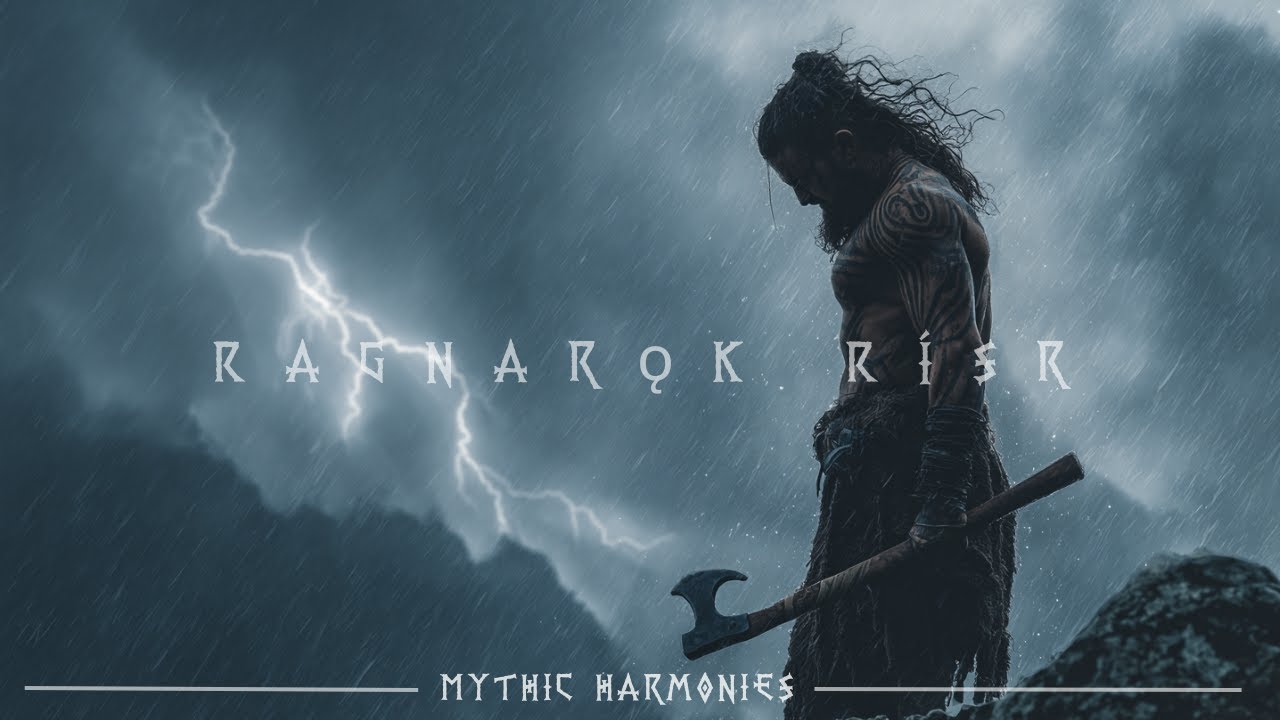
Ragnarǫk Rísr (“Ragnarök Rises”) is a 3:16 Mythic Harmonies battle song built around a collective last stand: the sky burns, Fenrir roars, and the repeated vér—“we”—keeps the focus on voices that choose to fight. Play the official recording above, then read the complete stylized Old Norse lyrics and English adaptation below.
This is a modern original composition inspired by Ragnarök, not a surviving Viking Age chant. Its language deliberately aims for an Old Norse atmosphere, but several lines are compressed, non-standard or translated freely for rhythm. Those limits are identified openly so the fiche can serve listeners without turning a song into a false historical document.
Ragnarǫk Rísr at a Glance
| Artist | Mythic Harmonies |
|---|---|
| Type | Modern original song inspired by Norse myth |
| Duration | 3:16 |
| Language | Stylized Old Norse with an English adaptation |
| Core image | A collective voice holding its ground as Ragnarök begins |
| Official recording | YouTube |
| Streaming status | No exact 3:16 title-and-duration match verified on Spotify or Apple Music |
What Does Ragnarǫk Rísr Mean?
Ragnarǫk Rísr is intended to mean “Ragnarök Rises” or “Ragnarök is rising.” Rísr is the third-person singular present of rísa, “to rise.” The song treats Ragnarök almost as a force arriving over the horizon, which is why the title returns as its central call.
Ragnarök is commonly explained as the fate or doom of the divine powers. “Twilight of the gods” is famous in modern culture, especially through later German reception, but it should not be presented as a secure literal translation of the medieval term. The spelling Ragnarǫk follows a normalized Old Norse form using ǫ.
What Story Does the Song Tell?
The opening verse establishes an immediate catastrophe: a burning sky, thunder, rushing wind, a wolf and a giant. The refrain then changes scale. Instead of cataloguing every event in the myth, it brings in an unnamed collective voice: “We rise together.” That choice makes Ragnarǫk Rísr a battle song rather than a narrative retelling of the Eddas.
The second full verse names Fenrir, shows swords and shields in firelight, and lets the earth shake beneath the “fading days.” The final refrain does not announce victory. It holds one musical idea in place—“The world shall fall, yet we hold on”—before the sparse ending reduces the song to title and motion: “Rises… to war…”
The lyrics never identify the speakers as historical Vikings, einherjar or a named group from the sources. They are best understood as the song’s dramatic chorus. That distinction matters: it preserves the force of the performance without inventing a missing character list.
How the Refrain Creates the Last-Stand Feeling
The track’s identity comes from repetition. Styrkr í brjósti, eldr í blóð compresses strength, chest, fire and blood into a hard two-part line; vér rísum saman then converts private resolve into collective motion. The chorus repeats the title before almost every claim, so Ragnarök functions both as setting and rhythmic downbeat.
That architecture is also what separates this fiche from Ragnarǫk Rís. The other song is a 3:09 prophecy montage distributed as Ragnarok Rising; this 3:16 recording is organized around “we fight the war,” “we rise together” and the closing til stríðs. They share a mythic event, but not the same recording, lyrics or search intent.
Fenrir, the Wolf and the Giant
The first stanza says “the wolf” without naming it. Later, however, the song explicitly gives Fenrir a roar, so the track itself connects its wolf imagery with the best-known wolf of Ragnarök. In the medieval accounts, Fenrir breaks free and Odin meets the wolf during the final conflict. For the source tradition rather than this song’s adaptation, see the dedicated guide to Fenrir in Norse mythology.
The line translated as “A giant climbs from the depths of Hel” is more clearly modern poetic imagery. Norse jötnar are not simply one underground army, and Hel should not be treated as the generic home of every giant. The sources describe multiple beings and forces converging on the final crisis; the lyric condenses that much more varied material into a single dark ascent.
“We Shatter Fate”: Refrain, Not Doctrine
“With fire and steel we shatter fate” is the English adaptation of Eldr ok stáli, brjótum tíð. It is a forceful hook, but it should not be used as proof that all pre-Christian Scandinavians shared one fixed philosophy of heroic defiance. The medieval texts stage foreknowledge, decision, loss and renewal in different ways; they do not hand us a single slogan called “the Norse worldview.”
Within the song, the line has a precise dramatic job: it lets the chorus act against a disaster whose outcome appears larger than them. “Shatter fate” and “forge the time” are therefore best read as English performance lines, not close dictionary translations or quotations from an Eddic poem.
Ragnarök in the Sources and in This Song
The Poetic Edda and Snorri Sturluson’s Gylfaginning preserve important but not identical evidence for Ragnarök. Fire, the wolf, cosmic collapse and the deaths of gods belong to that source world. So do survival and renewal: Ragnarök is not presented only as undifferentiated total destruction.
Ragnarǫk Rísr selects the battle-facing images because they suit a compact war song. It does not try to include every named combatant, and its lyrics do not name Surtr, Odin, Thor or Jörmungandr. Readers looking for the sequence, manuscript evidence and variations should use the full guide to Ragnarök in Norse mythology; this page remains the fiche for one specific song.
Old Norse Language Note
The text mixes recognizable Old Norse vocabulary with compressed or uncertain constructions created for metre and sound. Clear elements include himinn (sky), vindrinn (the wind), vér rísum saman (we rise together), sverð (sword), Fenrir, goðin (the gods) and heimr (world). The spelling Ulfrinn would normally be normalized as úlfrinn.
Other phrases—including ulfrinn hræskr, fjandr í hróp, eldr í blóð, brjótum glóð, berjum stríð, stöndum dreng, hjǫrtu þjóa, undir dǫgum síð and vér fæðum tíð—are non-standard, ambiguous or grammatically strained. The English below is the song’s singable adaptation, not a word-for-word scholarly translation. The wording is preserved exactly as performed so listeners can follow the recording.
Is Ragnarǫk Rísr an Authentic Viking Song?
No. It is a modern Mythic Harmonies composition using medieval mythic material and stylized Old Norse. No manuscript, runic inscription or historical source preserves these lyrics or this melody. Its authenticity lies in transparent inspiration and careful separation between documented myth and modern creative choices—not in a claim of Viking Age survival.
Ragnarǫk Rísr Lyrics (Old Norse and English)
The performance text appears first exactly as sung, followed by its English adaptation.
Old Norse:
Ragnarǫk rísr, himinn brenn,
Þrumur kalla, vindrinn renn.
Ulfrinn hræskr, fjandr í hróp,
Jǫtunn stígr úr heljar djúp.Styrkr í brjósti, eldr í blóð,
Vér rísum saman, brjótum glóð.Ragnarǫk rísr, vér berjum stríð,
Eldr ok stáli, brjótum tíð.
Ragnarǫk rísr, vér stöndum dreng,
Þursar falla, vér höggum leng.Sverð í loga, skildir glóa,
Fenrir rýtr, en hjǫrtu þjóa.
Jǫrðr skelfr undir dǫgum síð,
Goðin bregðast, vér fæðum tíð.Styrkr í brjósti, eldr í blóð,
Vér rísum saman, brjótum glóð.Ragnarǫk rísr, vér berjum stríð,
Eldr ok stáli, brjótum tíð.
Ragnarǫk rísr, vér stöndum dreng,
Heimr skal falla, vér höldum leng.Ragnarǫk… rísr…
Rísr… til stríðs…
English translation:
Ragnarök rises, the sky burns,
Thunder calls, the wind rushes.
The wolf tears, enemies scream,
A giant climbs from the depths of Hel.Strength in the chest, fire in the blood,
We rise together, breaking the embers.Ragnarök rises, we fight the war,
With fire and steel we shatter fate.
Ragnarök rises, we stand as men,
The giants fall, we strike again.Swords in flame, shields glowing,
Fenrir roars, yet hearts beat fast.
The earth trembles under the fading days,
The gods falter, we forge the time.Strength in the chest, fire in the blood,
We rise together, breaking the embers.Ragnarök rises, we fight the war,
With fire and steel we shatter fate.
Ragnarök rises, we stand as men,
The world shall fall, yet we hold on.Ragnarök… rises…
Rises… to war…
Sources Used for the Myth and Language Notes
- Edward Pettit, trans., The Poetic Edda, open-access critical translation and commentary.
- Anthony Faulkes, ed., Snorri Sturluson, Edda: Prologue and Gylfaginning, Viking Society for Northern Research.
- University of Copenhagen, Dictionary of Old Norse Prose, for lexical checking.
Where to Listen
Watch the exact 3:16 Ragnarǫk Rísr video on YouTube. Authenticated catalogue searches found Ragnarok Rising by Mythic Harmonies at 3:09, but no separate Spotify or Apple Music release matching this fiche’s title and 3:16 duration. To avoid sending listeners to the wrong song, use the official Spotify artist page and Apple Music artist page.
What does Ragnarǫk Rísr mean?
Ragnarǫk Rísr is intended to mean “Ragnarök Rises.” Rísr is the Old Norse third-person singular present of rísa, “to rise.” The title frames Ragnarök as a force arriving while the song’s collective voice prepares to fight.
What is the Ragnarǫk Rísr song about?
It is a modern last-stand battle song inspired by Ragnarök. A collective “we” faces a burning sky, a wolf, a giant, Fenrir and the faltering of the gods. The track emphasizes rising together rather than retelling every event in the medieval sources.
Who are the warriors speaking in Ragnarǫk Rísr?
The lyrics do not identify the speakers as historical Vikings, einherjar or any named mythological group. They function as the song’s dramatic collective chorus, so assigning them a more specific identity would go beyond the text.
Is Ragnarǫk Rísr an authentic Viking Age song?
No. Ragnarǫk Rísr is a modern Mythic Harmonies composition inspired by medieval Norse myth. Its Old Norse is stylized and includes compressed or non-standard phrases; no historical source preserves these lyrics or this melody.
Where can I listen to Ragnarǫk Rísr?
The exact 3:16 recording is available in the official Mythic Harmonies YouTube video embedded on this fiche. No separate Spotify or Apple Music master matching both the title and duration was verified, so the page links to the artist profiles instead of an unrelated track.
More from Epic War Battle
March with the War-Band
New Old Norse chants every month. Join the listeners who never miss a release.