
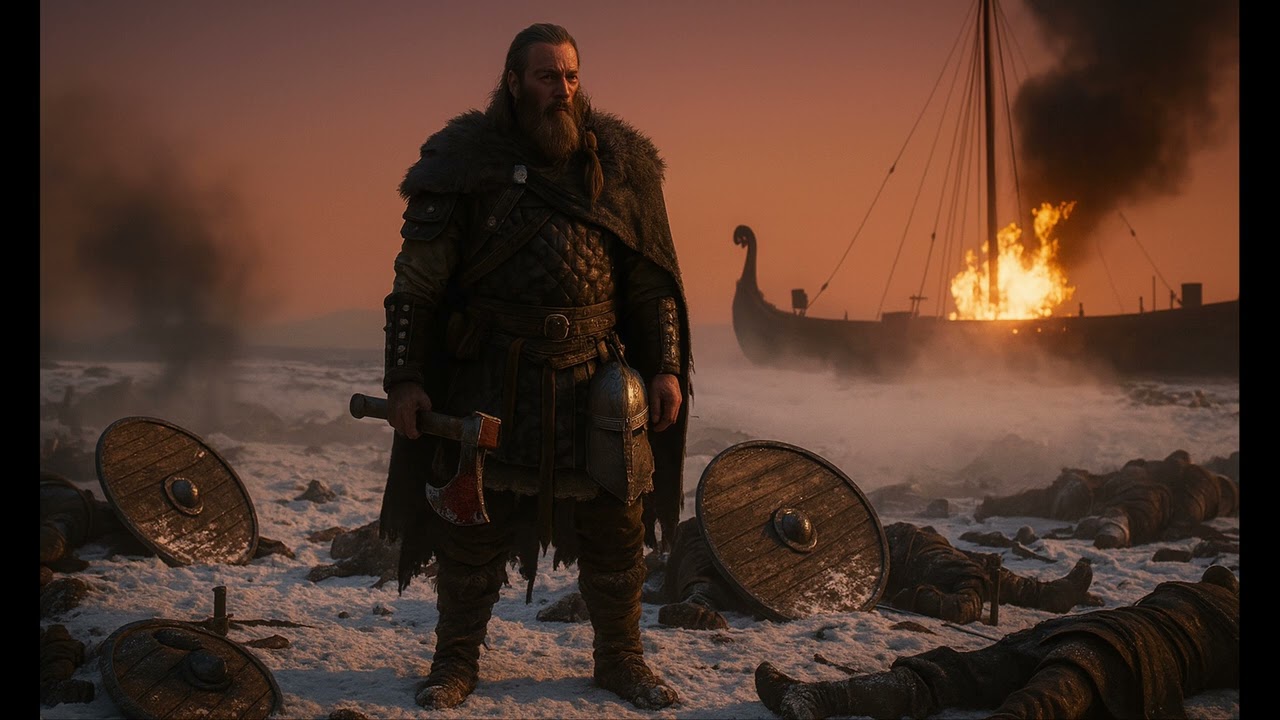
Blóð fyrir Norðr (“Blood for the North”) is a 4:22 Mythic Harmonies war chant that moves from blood on snow to a longship crossing a red sea. Five continuous stanzas bind weapons, thunder-like shields, names carved into earth, an oath of blood and a final refusal to kneel.
Play the complete YouTube master above. Apple Music carries the exact 4:22 release as Blood for the north. Authenticated Spotify searches found no track matching both this title and duration, so the official artist page is retained there instead of attaching a different blood-themed song.
Blóð fyrir Norðr at a Glance
| Artist | Mythic Harmonies |
|---|---|
| Song | Blóð fyrir Norðr / Blood for the North |
| YouTube master | 4:22 |
| Apple Music | 4:22, exact English title and artist |
| Spotify | No exact master confirmed; artist fallback retained |
| Language | Old Norse-styled text with English artistic translation |
| Status | Original modern composition |
What Is Blóð fyrir Norðr About?
The first stanza places blood on snow and fire in the eyes as weapons rise beneath a northern sky. The second turns shields and feet into the song’s percussion, while steel, bone and Odin’s path make the advance merciless. The third gives the warriors iron hearts and lets every axe blow become a “poem of death.”
The fourth moves outward: a waiting raven, growing fire, red water and a longship carry the oath beyond land. The last stanza compresses the group into wolf, wind, ash and bone, then ends on conquest and refusal. The progression is snowfield → march → carved memory → sea crossing → collective vow.
What Does “Blóð fyrir Norðr” Mean?
The title is intended to mean Blood for the North: blóð is “blood,” fyrir is “for/before,” and norðr expresses north or northward direction. As a slogan-like title, however, it follows modern English phrasing more closely than a secure fixed Old Norse formula.
It should therefore be read as the recording’s established name, not as a documented Viking motto, oath or battle cry. The Apple Music title confirms the intended English identity without proving a medieval expression.
Snow, Longship and the Song’s Northern Frame
The north in this song is a dramatic landscape: snow, mountain, storm, sea and longship. Viking Age seafaring and armed expeditions are well documented, but not every voyage was a raid and not every Scandinavian life was organized around war. The National Museum of Denmark’s overview of different kinds of Viking expeditions stresses trade, travel and settlement alongside conflict.
The red sea and land-taking finale belong to the narrator’s violent campaign. They are not a summary of “the Viking mindset,” nor does the track identify a historical army, shore or conquest.
Weapons, Raven and Reputation
Swords, axes, shields and longships fit the material vocabulary of the Viking Age. The National Museum’s weapons evidence also shows unequal access: swords could be elite objects, while axes were more broadly available. That supports the setting without turning the lyrics into an eyewitness report.
The waiting raven is not named Huginn or Muninn and need not be treated as an omen sent by Odin. “Names in the earth” and glory beyond fire connect with the broader importance of reputation, but the lyric does not mention runes and should not be paraphrased as warriors carving magical signs. Hávamál 76–77 supplies the reliable literary parallel for renown surviving mortal life.
How the Recording Builds Its March
The song has no repeating chorus block. Instead, parallel openings—blood, shields, names, raven, wolf—keep resetting the scene while percussion pushes it forward. That continuous form suits a march: each stanza adds a new location or vow without returning to a single hook.
“Feet like drums” is inside the text itself; the arrangement then reinforces it through weight and repetition. This does not prove how a Viking war-band marched, what instruments it carried or that shields were struck in rhythm before battle.
Old Norse Language Note
The released text is preserved exactly below. It mixes recognizable Old Norse vocabulary with modern forms and grammatical irregularities. Við is used where Old Norse expects first-person plural vér; vápn vǫxum does not literally mean “weapons rise”; trommur is a modern-looking drum word; and ekkert miskunn does not show the expected gender agreement.
Later lines add hver högg instead of neuter hvert hǫgg, and kvað is not the noun “poem” supplied by the translation. The English is therefore an artistic adaptation, not a literal edition. Michael Barnes’s A New Introduction to Old Norse supplies the grammatical baseline.
Where This Fiche Fits
This page owns the exact Blóð fyrir Norðr / Blood for the North intent: the 4:22 master, snowfield, five-stanza march, longship, red sea and final refusal to kneel. Blóð ok Æra remains the separate wolf-and-lamb “Blood and Honor” song. Browse all distinct recordings in the Music catalogue.
Blóð fyrir Norðr Lyrics & Translation
The Old Norse-styled text and English artistic translation are reproduced without silent correction.
Original Old Norse-Styled Text
Blóð á snjǫ́, eldr í augum, Vápn vǫxum undir norðrhimni. Goðin sjá, stormr kemr nær, Við syngjum víg, við brennum ótta.
Skjǫldr sem þrumr, fǿtr sem trommur, Frá fjalli kemr ópið stríðs. Stál mun syngja, bein mun brotna, Ekkert miskunn í Óðins spor.
Við rítum nöfn í jǫrð, Með reiði, með hjarta úr járni. Øx gellir sem forn andi, Hver högg er dauðans kvað.
Hrafn bíðr, eldrinn vex, Sjórinn rauðr þar sem langskip ferr. Eiðr er blóð, leið er sársauki, En frægð kallar handan loga.
Með úlfi ok vindi, með ösku ok beini, Berjumst sem einn, deyjum einir. Stríð er allt, kvæðit er stál, Tökum land, beygjumst ei.
English Artistic Translation
Blood on snow, fire in eyes, Weapons rise under the northern sky. The gods see, the storm comes near, We sing of slaughter, we burn away fear.
Shields like thunder, feet like drums, From the mountain comes the cry of war. Steel shall sing, bones shall break, No mercy in Odin’s path.
We carve names into the earth, With rage, with hearts of iron. The axe screams like an ancient spirit, Every blow is a poem of death.
The raven waits, the fire grows, The sea turns red where the longship goes. The oath is blood, the way is pain, But glory calls beyond the flames.
With wolf and wind, with ash and bone, We fight as one, we die alone. War is all, the poem is steel, We take the land, we do not kneel.
Where to Listen
Listen to the exact 4:22 release as Blood for the north on Apple Music. Spotify uses the official Mythic Harmonies artist page because no matching master was found. Browse the full lyric catalogue in the Songbook.
Sources and Editorial Method
- National Museum of Denmark, “Different types of expeditions” and “Viking weapons.”
- Edward Pettit, Hávamál, especially stanzas 76–77 on reputation.
- Michael Barnes, A New Introduction to Old Norse, Part I: Grammar.
Frequently Asked Questions
What does Blóð fyrir Norðr mean?
The title is intended to mean “Blood for the North.” It is an established modern song title, not a documented Viking Age motto or oath.
What is Blóð fyrir Norðr about?
Five continuous stanzas move from blood on snow and a war march to carved names, a raven, a red sea, a longship and a final refusal to kneel.
Is Blóð fyrir Norðr an authentic Viking chant?
No. It is an original Mythic Harmonies composition. Weapons, longships and the value of reputation have historical parallels, but the campaign, melody and exact words are modern.
Are the lyrics grammatical Old Norse?
They contain recognizable vocabulary alongside modern forms and non-standard grammar. This fiche labels them Old Norse-styled and the English as an artistic translation.
Where can I listen to Blood for the North?
The 4:22 YouTube master is embedded at the top and the exact 4:22 Apple Music release is linked below. No matching Spotify master was confirmed, so the artist page is used there.
More from Epic War Battle
March with the War-Band
New Old Norse chants every month. Join the listeners who never miss a release.