
What Is Þagnar Hár?
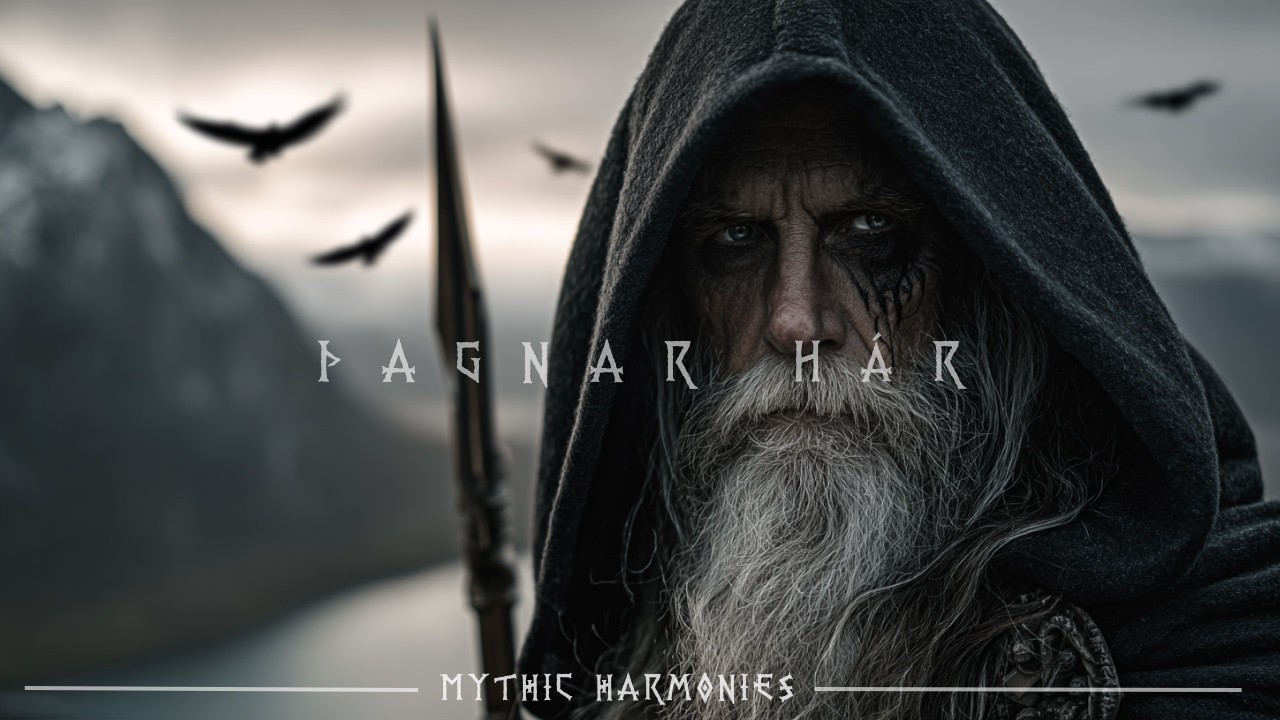
Þagnar Hár (“The High One Falls Silent”) is a 3:53 Mythic Harmonies Odin chant in stylized Old Norse. It imagines a pause before Ragnarök: ravens circle, the spear rests, the chained wolf moves, and Odin sees what is approaching without speaking.
- Artist: Mythic Harmonies
- Official video: 3:53 on YouTube
- Language: stylized Old Norse with an official English adaptation
- Core scene: Odin silently carrying foreknowledge of the end
- Historical status: an original modern portrait assembled from attested names and mythic images
Hár is an attested Odin-name, Huginn and Muninn are his ravens, and medieval poems connect him with the spear, the self-sacrifice on the tree and knowledge of Ragnarök. No cited source preserves one scene in which all the details below occur together. The silence is the composition’s interpretive centre.
The Song’s Story: The Weight of Knowing
The track begins after motion has already started. Ravens fly, but wind and speaker fall silent. Odin sits in darkness with one eye turned toward an end he cannot unknow. His spear is not raised for battle; it rests against stone while his mind travels ahead.
The refrain strips the god of speech but not agency. The ravens turn, the world freezes, the spear rests and the end rises. In the second half, future actors stir at the edge of the scene: Fenrir tests his fetter, a son waits in shadow, and fire sleeps in wood. The lyric does not explain every figure, allowing foreknowledge to feel like pressure rather than exposition.
The final sequence returns power to the silent figure. His eye burns, blood will fall and Ragnarök approaches, yet he still stands. Wind breathes and the raven sees; Hár remains silent. The ending makes endurance under knowledge—not a new prophecy—the song’s subject.
What Does Þagnar Hár Mean?
Þagnar means “falls silent” or “becomes silent.” Hár means “High One” and is used as an Odin-name. “The High One Falls Silent” is therefore the intended title. The phrase is not presented as the title of a medieval poem or a quotation from one.
Who Is Hár in Norse Mythology?
In Grímnismál, Odin ends a long sequence of self-identifications by naming himself in many ways. Hávamál is conventionally “Sayings of the High One,” and its speaking authority is associated with Odin across its composite sections. Snorri also uses Hár as one of the enthroned speakers in the frame of Gylfaginning.
The name does not mean that every appearance of the ordinary adjective “high” is automatically Odin. In this title, however, the ravens, one eye, spear and Ragnarök context make the intended identity explicit.
Odin’s Ravens and His Fear of Their Return
Grímnismál 20 says that Huginn and Muninn fly over the world each day and that Odin fears for their return—especially Muninn. That short stanza gives the ravens emotional weight beyond simple reconnaissance. Thought and memory can travel, but their absence makes knowledge vulnerable.
Þagnar Hár does not quote that stanza. It uses the circling ravens as silent witnesses and makes their movement contrast with Odin’s stillness. Óðins Hrafnar remains the dedicated song page for Huginn and Muninn themselves.
Did Odin Know the Outcome of Ragnarök?
Vǫluspá presents a seeress recounting the world’s past and future before Odin, including the gods’ catastrophe and renewal. Other sources show him seeking knowledge and preparing for the final conflict. It is reasonable to read Odin as knowing much of the approaching disaster, but the surviving poems do not reduce that knowledge to one uniform omniscient script.
The song turns this source tension into psychology: a god can act, gather knowledge and prepare, yet still carry an ending he cannot simply cancel.
Language and Translation Note
The Old Norse is a modern rhythmic text, not a normalized manuscript transcription. Some phrases are compressed, and the official English occasionally names an implication more directly: rǫk nálgast becomes “Ragnarök draws near.” The bilingual text below preserves the released form while this commentary identifies it as artistic language.
How This Odin Song Stays Distinct
This fiche owns the title Þagnar Hár, the 3:53 master and Odin’s silent pre-Ragnarök vigil. Óðins Hrafnar owns the raven-flight intent, while Dómr Alfǫðrs stages a fallen warrior awaiting the Allfather’s verdict. The pages share a deity but answer different song queries.
Þagnar Hár Lyrics
The complete text follows the official video description.
Old Norse
Hrafnar fljúga. Vindr þagnar. Einn sitr.
Hár sitr einn í myrkri,
auga eitt sér lengra en sól.Spjót hans hvílir við stein,
hugr hans gengr um enda.Blóð man spor í jǫrð,
askr skelfr í draumi.Fjǫll þegja í skugga,
heimr bíðr sinn dóm.Óðinn veit. Óðinn sér. En mælir ei.
Þagnar Hár. Hrafnar snúast.
Þagnar Hár. Heimr frýss.
Þagnar Hár. Spjót hvílir.
Þagnar Hár. Endr rís.Rúnir falla í mold,
vindr ber forn nöfn.Úlfr hrærir fjǫtr sinn,
keðjur titra í jǫrð.Sonr bíðr í skugga,
eldr sefr í viði.Allt man hinn eini,
þó heimr lokist.Hann reis. Hann gaf. Hann bíðr.
Þagnar Hár. Auga logar.
Þagnar Hár. Blóð mun falla.
Þagnar Hár. Rǫk nálgast.
Þagnar Hár. En stendr enn.Vindr andar. Hrafn sér. Hár þegir.
English Translation
The ravens fly. The wind falls silent. One sits alone.
The High One sits alone in darkness,
one eye sees further than the sun.His spear rests against the stone,
his mind walks toward the end.Blood remembers tracks in the earth,
the ash tree trembles in its dream.Mountains fall silent in shadow,
the world awaits its judgment.Odin knows. Odin sees. But does not speak.
The High One falls silent. The ravens turn.
The High One falls silent. The world freezes.
The High One falls silent. The spear rests.
The High One falls silent. The end rises.Runes fall into the earth,
the wind carries ancient names.The wolf stirs at his chains,
the fetters tremble in the earth.The son waits in shadow,
fire sleeps in the wood.The solitary one remembers all,
though the world closes in.He rose. He gave. He waits.
The High One falls silent. The eye burns.
The High One falls silent. Blood will fall.
The High One falls silent. Ragnarök draws near.
The High One falls silent. But still he stands.The wind breathes. The raven sees. The High One is silent.
Listen to the Official Recording
Watch the official 3:53 Þagnar Hár video on YouTube. No exact same-title Mythic Harmonies master was found on Spotify or Apple Music under the title, artist and ±1-second duration rule. The fiche therefore uses the verified Spotify and Apple Music artist pages.
Sources and Further Reading
- Edward Pettit (ed. and trans.), Grímnismál, for Odin’s names and the stanza on Huginn and Muninn.
- Edward Pettit (ed. and trans.), Hávamál, including Odin’s self-sacrifice and acquisition of runes.
- Viking Society for Northern Research, Snorri Sturluson, Edda: Prologue and Gylfaginning, for the medieval prose synthesis of Odin and Ragnarök.
What does Þagnar Hár mean?
It means The High One Falls Silent. Þagnar means becomes silent, and Hár, the High One, is an attested name associated with Odin.
What is the Þagnar Hár song about?
It imagines Odin sitting in silence as ravens circle, Fenrir stirs and Ragnarök approaches. The subject is the burden of foreknowledge rather than a newly invented prophecy.
Is Þagnar Hár an authentic Old Norse Odin chant?
No. It is an original modern Mythic Harmonies composition in stylized Old Norse. Hár, the ravens and Ragnarök are source-based, but this combined scene, wording and melody are new.
Is Hár another name for Odin?
Yes in the relevant medieval contexts. Hár means High One and appears among Odin’s names and Odin-associated speaking figures, while the song’s ravens, eye and spear make the intended identity explicit.
Where can I listen to Þagnar Hár by Mythic Harmonies?
The verified official recording is the 3:53 YouTube video. No same-title artist-and-duration match was confirmed on Spotify or Apple Music, so the fiche uses Mythic Harmonies artist-page fallbacks.
More from Mythology & Gods
March with the War-Band
New Old Norse chants every month. Join the listeners who never miss a release.