
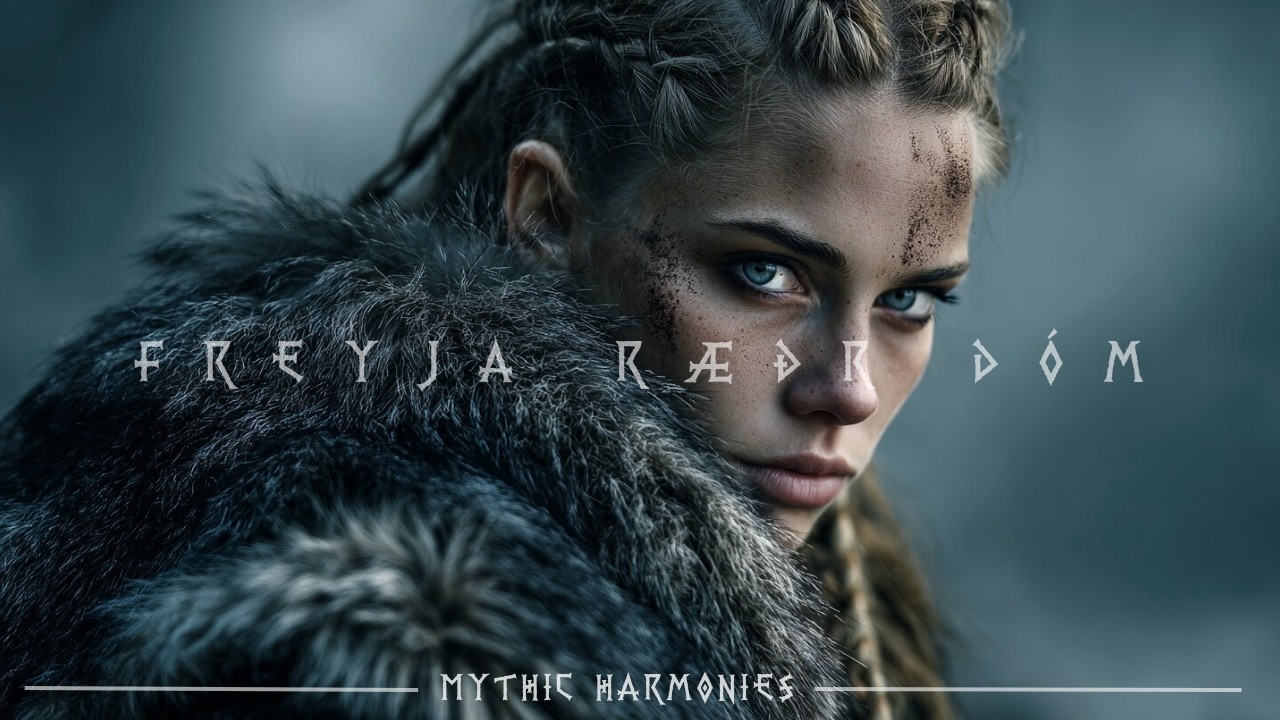
What Is Freyja ræðr dóm?
Freyja ræðr dóm, presented in English as Freyja Passes Judgment, is a 3:39 original Mythic Harmonies song in stylized Old Norse with an official English translation. Its quiet, severe scene follows Freyja among the fallen as she makes a choice no living witness can hear.
- Artist: Mythic Harmonies
- Official video: 3:39 on YouTube
- Languages: stylized Old Norse with official English translation
- Intended title meaning: Freyja Passes Judgment
- Core search intent: title meaning, bilingual lyrics and Fólkvangr context
- Historical status: modern dramatic scene built around one attested fact: Freyja receives a share of the battle-slain
The song is not a recovered Viking Age hymn and its verdict ritual is not described in an Eddic poem. Its historical anchor is narrower and more interesting: stanza 14 of Grímnismál associates Freyja with Fólkvangr and says that she chooses half of the slain each day while Odin has the other half. The poem does not explain a courtroom, a moral test or a sequence in which every warrior is judged.
What Does Freyja ræðr dóm Mean?
The intended sense is “Freyja passes judgment” or “Freyja decides the verdict.” The title presents Freyja as the subject, ræðr as the act of deciding or ruling, and dóm as judgment. It is an original song title rather than a quotation from Grímnismál, a runic formula or a historical name for a rite.
That distinction matters because the refrain turns a brief source statement—Freyja chooses—into a complete dramatic action. The words “blood and soul,” the weighed heart and the silent verdict belong to the composition’s imagery. They should be read as narrative poetry, not as a handbook of Norse afterlife procedure.
The Song’s Story: A Choice Made in Silence
The opening reduces the battlefield to silence: “Freyja stands.” Gold, spectacle and victory disappear. She walks through Fólkvangr, sees what has fallen and weighs what remains. The repeated short clauses give the scene the pace of a ritual, but the ritual itself is the songwriter’s construction.
A second movement makes the imagined judgment more intimate. Freyja takes neither sword nor shield; wounds seem to speak when oaths and praise cannot. The lyric therefore asks an ethical question rather than giving an archaeological answer: if reputation is stripped away, what would courage look like to a divine witness?
The ending does not send the chosen person to a named hall or describe a journey. It stops at the decision—“The choice is made and the world falls silent.” That restraint keeps the emotional centre on selection, separating this track from broader songs about Valhalla or the journey of the dead.
Freyja, Fólkvangr and the Battle-Slain in the Sources
The primary evidence is Grímnismál 14. In Edward Pettit’s open-access edition of the Poetic Edda, Fólkvangr is the ninth dwelling and Freyja chooses half of the slain each day; Odin has the other half. The stanza establishes division, not a hierarchy between the two recipients and not a detailed mechanism.
Snorri Sturluson later names Freyja’s hall Sessrúmnir in Fólkvangr. Both texts are medieval witnesses to traditions about pre-Christian gods, so they deserve attribution rather than being treated as a transcript from the Viking Age. For a broader portrait of the goddess, see Mythic Harmonies’ evidence-led guide to Freyja in Norse mythology.
This fiche deliberately does not claim that Freyja receives the “most honourable” dead, examines their wounds, weighs their hearts or chooses before Odin. Those details are absent from the stanza. The song can stage them as fiction; the source note must leave the gap visible.
How This Track Differs from Other Freyja Songs
Freyja ræðr dóm owns one narrow intent: a solo judgment scene and the meaning of its title. Odin & Freyja’s Judgment dramatizes the division between two divine recipients, while the catalogue’s other Freyja songs explore seiðr, love, gold or the goddess’s wider identity. Keeping those themes separate prevents every Freyja fiche from answering the same query with interchangeable text.
Musically, the restrained pacing, pauses and repeated name make the track suitable for close listening, myth-inspired role-playing scenes and dark ceremonial ambience. That atmosphere is modern artistic interpretation. Nothing in the cited stanza tells us what a song about Fólkvangr sounded like.
Freyja ræðr dóm Lyrics and English Translation
The bilingual lyrics below follow the official Mythic Harmonies video description. The Old Norse is a stylized modern lyric, not a diplomatic edition of a medieval manuscript.
Old Norse
Þögn fellr. Freyja stendr.
Í Fólkvangi gengr hon hljóð, gull ei skín, en dómr er harðr.
Augun sjá þat sem fellr, hverr skal lifa, hverr skal farð.
Engi grátur. Engi orð. Hjarta vegit. Örlǫg skorin.
Freyja ræðr dóm. Blóð ok sál.
Freyja velr þá er féllu vel.
Freyja ræðr dóm. Í mold ok ljósi.
Engi flótti frá hennar máli.
Hon nemr ei sverð né skjǫld, hon nemr hug ok síðast spor.
Sár segja meir en orð, þar er hugr stóð fastast forð.
Engi loforð. Engi eiðr. Aðeins vegit þat sem var.
Freyja ræðr dóm. Blóð ok sál.
Freyja velr þá er féllu vel.
Freyja ræðr dóm. Í mold ok ljósi.
Engi flótti frá hennar máli.
Freyja stendr. Freyja sér.
Val er gjǫrt ok heimr þegir.
Þögn lifir. Freyja…
English Translation
Silence falls. Freyja stands.
In Fólkvangr she walks in silence, no gold shines, but the judgment is hard.
The eyes see what has fallen, who shall live, who shall depart.
No weeping. No words. The heart weighed. Fate carved.
Freyja passes judgment. Blood and soul.
Freyja chooses those who fell with honour.
Freyja passes judgment. In earth and light.
No escape from her verdict.
She takes no sword and no shield, she takes the spirit and the last footstep.
Wounds speak more than words, where the will held longest before.
No promises. No oath. Only what was is weighed.
Freyja passes judgment. Blood and soul.
Freyja chooses those who fell with honour.
Freyja passes judgment. In earth and light.
No escape from her verdict.
Freyja stands. Freyja sees.
The choice is made and the world falls silent.
Silence lives. Freyja…
Listen to the Official Recording
Watch the verified 3:39 Freyja ræðr dóm video on YouTube. Searches of Spotify and Apple Music did not return an exact Mythic Harmonies title-and-duration match, so this fiche uses the verified Spotify artist page and Apple Music artist page instead of guessing a track URL.
Sources and Further Reading
- Edward Pettit, trans., The Poetic Edda, Open Book Publishers, especially Grímnismál 14 for Fólkvangr and the division of the slain.
- Snorri Sturluson, The Prose Edda, Viking Society for Northern Research editions, for the medieval prose description of Freyja and Sessrúmnir.
What does Freyja ræðr dóm mean?
The intended English title is Freyja Passes Judgment. It is a modern composition title, not a surviving Eddic line or rune formula.
What is Freyja ræðr dóm about?
The song imagines Freyja silently examining the fallen and making a choice, turning the brief source statement that she chooses half the slain into a modern dramatic scene.
Does Norse mythology say Freyja judges every fallen warrior?
No surviving source cited here describes a universal trial, wound-reading ritual or moral verdict. Grímnismál 14 says she chooses half of the slain and Odin has the other half.
Is Freyja ræðr dóm an authentic Viking Age chant?
No. It is an original Mythic Harmonies composition in stylized Old Norse, informed by Norse literature but not presented as a recovered historical song.
Where can I listen to Freyja ræðr dóm?
The verified official recording is the 3:39 YouTube video. No exact Spotify or Apple Music master matched the title and duration, so artist-page fallbacks are used.
More from Mythology & Gods
March with the War-Band
New Old Norse chants every month. Join the listeners who never miss a release.