
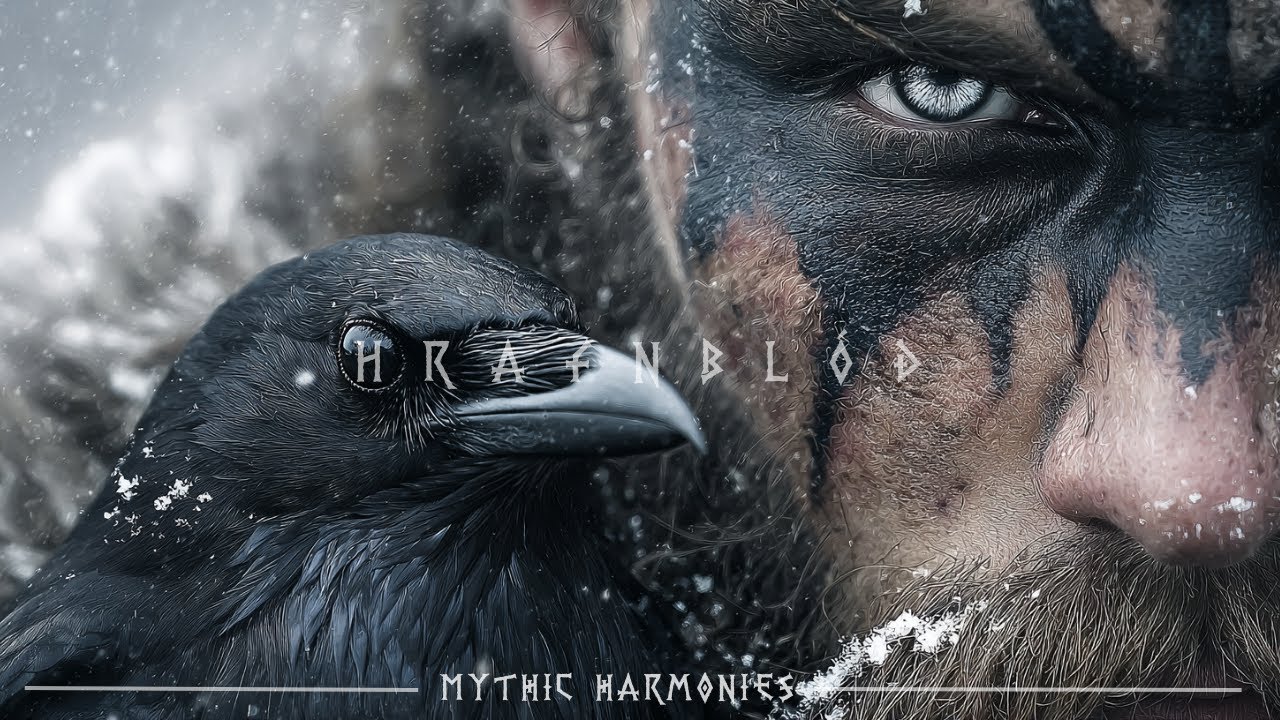
Hrafnblóð (“Blood of the Raven”) is a 4:10 Mythic Harmonies song about night-flying ravens, memory and an imagined “raven-blood” calling the narrator northward. Huginn and Muninn enter the second verse, but the track builds a new mystical journey around them rather than retelling one medieval source.
This page preserves the complete Hrafnblóð lyrics and their released English rendering. Odin’s two ravens and their daily flight are firmly attested. Their role here as guides through dreams, carriers of an ancient host and embodiments of sacred raven-blood belongs to this modern composition.
Hrafnblóð at a Glance
- Title: Hrafnblóð (“Blood of the Raven”)
- Artist: Mythic Harmonies
- Duration: 4:10 on the official YouTube video
- Named figures: Huginn and Muninn
- Central images: black wings, ancient sword-war, Hel’s glow, night, blood and a northern path
- Historical status: original modern song using stylized medieval-language text
What Does Hrafnblóð Mean?
Hrafn is “raven” and blóð is “blood,” so the title communicates “raven blood” or the released English form, “Blood of the Raven.” It is a modern poetic title, not a term cited here from an eddic poem, saga, inscription or ritual vocabulary.
The title and chorus are not identical: the page is called Hrafnblóð, while the repeated word in the published text is Hrafnablóð, with hrafna resembling a plural genitive, “of ravens.” Both forms are preserved because that difference is part of the released work; the page does not silently normalize one into the other.
Who Are Huginn and Muninn?
Huginn and Muninn are Odin’s two named ravens. Grímnismál 20 says they fly every day over the wide earth. Odin worries that Huginn may not return and then says he fears still more for Muninn. The short stanza establishes the birds, their journey and the god’s concern; it does not describe “raven-blood.”
Snorri’s later prose expands their routine. The ravens sit on Odin’s shoulders, bring him news of what they see and hear, leave at daybreak and return by the morning meal. The passage can be checked in the Viking Society’s edition of the Uppsala Edda. The site’s complete guide to Huginn and Muninn compares the full source record.
What Do Their Names Mean?
Huginn is conventionally translated as “Thought.” Muninn is commonly rendered “Memory” or “Mind,” from a word-family whose range is broader than one modern psychological label. “Thought and Memory” is a useful pair, but the surviving verses do not provide a complete theory of two halves of Odin’s consciousness.
In this song, Muninn sings while Huginn sees. Those actions fit the published English scene, but they are not quotations from Grímnismál. The poem gives both birds the same daily flight and reserves the emotional distinction for Odin’s greater fear over Muninn’s return.
Do the Ravens Fly Through All Nine Worlds?
The familiar claim that Huginn and Muninn survey “all Nine Worlds” is stronger than the wording usually cited. Grímnismál has them cross the wide earth, and Snorri says they fly over all the world. Neither passage supplies a nine-realm itinerary or a list of locations visited that day.
Likewise, Snorri says the ravens report what they have seen and heard; he does not say they make Odin literally omniscient. Hrafnblóð places their flight across sky, thunder, mountains and a northern realm, which is the geography of this song.
Why Do Ravens Belong in Battle Poetry?
Ravens are carrion birds, and medieval Norse battle poetry repeatedly presents them alongside eagles and wolves as beneficiaries of slaughter. Skáldskaparmál preserves raven names and verses in which ravens drink blood or are fed after combat. The Viking Society’s scholarly edition of Skáldskaparmál makes that poetic register visible.
This evidence explains the song’s “memory of ancient sword-war” and black wings carrying an old host. It does not make every raven an omen, every battlefield a ritual offering or every bird one of Odin’s two named companions.
Did Seeing Ravens Mean Odin Was Present?
Odin’s raven association is secure, and raven imagery could make a battle poem resonate with his sphere. The stronger rule—“seeing ravens meant Odin and fate were near”—is not established as a universal Viking Age belief by the cited evidence. An ordinary raven remained an ordinary bird unless a text, image or context gives us more.
Hrafnblóð deliberately erases that ordinary boundary. Its birds whisper divine words, watch through thunder and call to the narrator. Those functions create the track’s mystical atmosphere; they should be credited to the composition rather than projected backward as a standard omen manual.
What Is “Raven-Blood” in the Song?
The words never define raven-blood as a substance. It rises in the night, burns in Hel’s glow and calls to the narrator. That pattern makes it a metaphor for inherited memory, attraction to danger or identification with the watching birds—but each of those is an interpretation, not a historical definition.
No source cited here identifies raven blood as a standard sacrament, magical ingredient, warrior initiation or sign of descent from Odin. The track can leave the image unresolved. Its force comes precisely from joining a creature of the battlefield with the blood running beneath the stars.
Why Does the Second Verse Mention Hel?
The source-language line places Hrafnablóð “in Hel’s ember/glow,” while the English says “Raven-blood burns in Hel’s glow.” It is a brief underworld image, not a complete claim that Huginn and Muninn serve the goddess Hel, guide every soul to her realm or travel between her hall and Odin.
The song never explains whether heljar means the goddess, her realm or simply an underworld colouring. For the dedicated gates-and-descent narrative, use Heljar Dyr. Hrafnblóð keeps Hel as one flash inside a raven-and-memory song.
Memory Without an Invented Norse Doctrine
Memory matters throughout Norse literature and commemoration, but it was not one uniform doctrine in which ancestors literally guided every living person. Hávamál famously values the reputation left after death, and memorial inscriptions preserve names and relationships. Those are specific kinds of evidence.
The narrator’s mind being led “through the northern world” is the song’s inward journey. Muninn’s name enriches it, yet the medieval source does not say that this raven carries the memories of all wars, keeps the dead alive or transports ancestral wisdom into a modern listener.
How the Song Moves through Night
The first stanza sends anonymous ravens over the sky with whispered divine words and memories of weapons. The second names Muninn and Huginn, then introduces wind and Hel’s glow. Only in the chorus does raven-blood become the narrator’s personal call.
The later mountain scene adds fire, seeking souls and watchful birds. Under the stars, “our blood” connects human speakers to the title image before the chorus returns. The final isolated line—“Raven-blood calls to me”—leaves the journey open rather than showing arrival, prophecy fulfilled or a god visibly present.
How Literal Is the English Rendering?
The English block is a released artistic rendering, not a scholarly word-for-word translation. The source-language text is stylized and not uniformly normalized. Goða mór is rendered “the gods’ soil,” while tíð and minni forna sverða stríð are reshaped into “the tale of time” and “the memory of ancient sword-war.”
Several phrases are uncertain or non-standard, including dǫggva röst, þrumu bröst, dǫglum slóð, norðrs ver, rótin stygg, Hrafnar vaka halda varð and Í dǫkkum draumr hin forna slóð. “Dewy ridge,” “thunder’s chest,” “shadowed trail” and “northern world” are interpretive choices. Both published blocks remain unchanged below.
How Hrafnblóð Differs from the Other Raven Songs
Hrafnblóð owns the raven-blood refrain, night flight, Hel’s glow and northward inner journey. Óðins Hrafnar is the dedicated stylized-language song about Odin’s two birds as Thought and Memory. Fury of the Raven owns the English battlefield storm and final request to be carried to Odin’s hall.
Hrafnablót owns the modern raven-offering scene. Similar birds do not require identical search intent: one page answers the exact Hrafnblóð text and meaning, while the encyclopedic article owns the source question “who are Huginn and Muninn?”
Is Hrafnblóð an Authentic Viking Raven Chant?
No. It is an original modern Mythic Harmonies composition. Huginn, Muninn, their daily flight and raven imagery in battle poetry are source-based. This lyric, melody, raven-blood metaphor, Hel-glow scene and dream journey are modern.
The distinction does not weaken the track. It gives each element a clear provenance: medieval ravens provide the historical anchor, while the blood-call and northern passage show what the songwriter made from them.
Where to Listen to Hrafnblóð
Watch the official 4:10 Hrafnblóð video on YouTube. No matching Mythic Harmonies track with the same title and duration was found on Spotify or Apple Music during this verification, so the page keeps the official Spotify artist page and Apple Music artist page rather than assigning a different raven song.
Hrafnblóð Lyrics (Old Norse and English)
The complete released words follow. The first block preserves the stylized source-language text; the second preserves its published English artistic rendering.
Original Lyrics (Old Norse Style)
Hrafnar fljúga um himins spor
Hvísla orð af goða mór
Vængir svartir bera tíð
Minni forna sverða stríðMuninn syngr um dǫggva röst
Huginn sér í þrumu bröst
Vindrinn hrærir dǫglum slóð
Hrafnablóð í heljar glóðHrafnablóð rís í nótt
Vængir bera forna drótt
Hrafnablóð kallar mér
Leiðir hug um norðrs verSkuggar dansa um fjallsins hrygg
Eldar loga rótin stygg
Sálir leita norðrsins stað
Hrafnar vaka halda varðUndir stjǫrnum rennr várt blóð
Í dǫkkum draumr hin forna slóðHrafnablóð rís í nótt
Vængir bera forna drótt
Hrafnablóð kallar mér
Leiðir hug um norðrs verHrafnablóð kallar mér
English Translation
Ravens fly across the path of the sky,
Whispering words from the gods’ soil.
Black wings carry the tale of time,
The memory of ancient sword-war.Muninn sings along the dewy ridge,
Huginn sees through thunder’s chest.
The wind stirs the shadowed trail,
Raven-blood burns in Hel’s glow.Raven-blood rises in the night,
Wings bear the ancient host.
Raven-blood calls to me,
Guiding my mind through the northern world.Shadows dance on the mountain’s spine,
Fires burn at the fearful root.
Souls seek the northern place,
Ravens keep their watchful guard.Under the stars our blood runs,
Through dark dreams of the ancient path.Raven-blood rises in the night,
Wings bear the ancient host.
Raven-blood calls to me,
Guiding my mind through the northern world.Raven-blood calls to me.
What does Hrafnblóð mean?
Hrafn means ‘raven’ and blóð means ‘blood,’ so the title communicates ‘Raven Blood’ or ‘Blood of the Raven.’ The chorus instead uses Hrafnablóð; both released forms are preserved without claiming that either names a historical rite.
Who are Huginn and Muninn?
Huginn and Muninn are Odin’s two ravens. Grímnismál says they fly each day over the wide earth, while Snorri’s later prose says they return with news of what they have seen and heard.
Did Huginn and Muninn fly through all Nine Worlds?
The commonly cited texts say they cross the wide earth or all the world. They do not provide a nine-realm itinerary, so ‘all Nine Worlds’ is a modern expansion of the surviving wording.
Is Hrafnblóð an authentic Viking raven chant?
No. It is a modern Mythic Harmonies composition. Odin’s ravens and battlefield raven imagery are source-based, but this lyric, melody, raven-blood metaphor, Hel-glow scene and dream journey are modern.
Where can I listen to Hrafnblóð?
The official Mythic Harmonies video runs 4:10 on YouTube. No exact title-and-duration match was verified on Spotify or Apple Music, so this page keeps the official artist links instead of assigning a different raven track.
More from Mythology & Gods
March with the War-Band
New Old Norse chants every month. Join the listeners who never miss a release.