
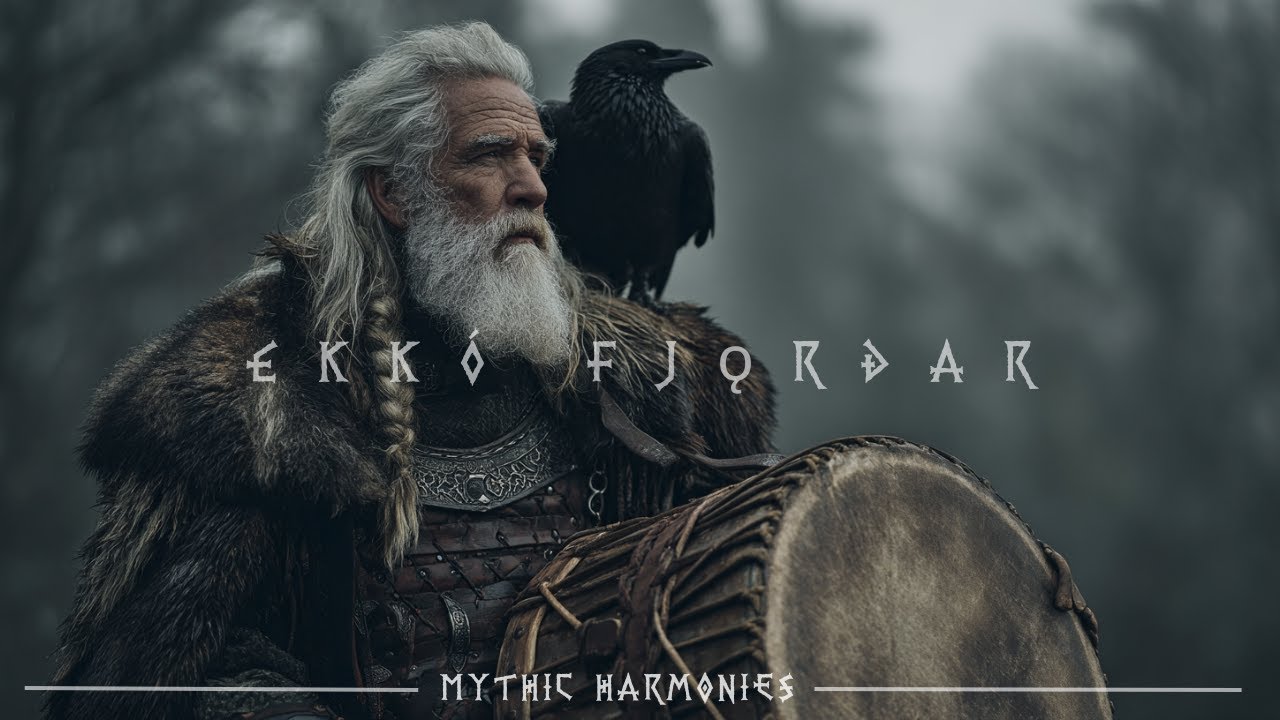
Ekkó Fjǫrðar is a modern Mythic Harmonies song performed in stylized Old Norse and released with an English rendering, “Echoes of the Fjord.” An older speaker listens to water, wind, stone and thunder until family memory feels present in the landscape.
This page preserves the complete published Ekkó Fjǫrðar lyrics and English translation exactly as released. It also explains the title, the language choices and the medieval parallels behind the imagery without presenting the composition as a recovered Viking Age chant.
Ekkó Fjǫrðar at a Glance
- Track: Ekkó Fjǫrðar
- Artist: Mythic Harmonies
- Language: stylized Old Norse with an English artistic translation
- Official video: 4 minutes 21 seconds
- Intended title rendering: Echoes of the Fjord
- Core theme: ancestry experienced through memory, place and repetition
What Is Ekkó Fjǫrðar About?
The song begins at the scale of a landscape. Deep fjords, sleeping souls, wind and mountains make the past feel audible. Its chorus turns that setting into a recurring address: voices of earlier generations call through time, while rock and sea hold the narrator’s attention.
The middle verses make the idea personal. The father is remembered through thunder, the mother through a flowing river, and inherited wisdom through names associated with trees and stones. In the final verse, the speaker sees an aged face in the fjord and follows the footsteps of the dead. The last refrain changes the ancestors from something heard outside to something carried within.
How This Version Differs from Echoes of the Fjord
Ekkó Fjǫrðar and Echoes of the Fjord are companion releases, not two pages competing for the same text. This fiche owns the stylized Norse-language performance, the preserved transcription and the accompanying English translation. The other fiche owns the directly English performance and its exact released lyrics.
The English block below matches the wording heard in the companion song, but here it functions as the published meaning of the Norse-language version. Listeners looking for the English recording should use the companion page; readers checking the Norse text, its wording or its translation should remain here.
A Transparent Note on the Old Norse
This is a present-day composition, not a transcription from a manuscript, runestone or medieval poem. Its language is best described as stylized Old Norse: it draws on Norse vocabulary, spelling and inflection, but the released text is not uniformly normalized to one scholarly medieval standard. The spelling is retained because silent correction would change the work listeners actually hear and search for.
That distinction matters because “Old Norse” itself can be used broadly or narrowly. Michael Barnes’s Grammar explains the scope of the term and the conventions used for normalized Old West Norse. The Dictionary of Old Norse Prose then provides manuscript-based word forms and citations. These are reference standards for evaluating the song, not evidence that its modern lines survive in medieval sources.
What Does the Title Mean?
The intended English title is Echoes of the Fjord. The released spelling Ekkó Fjǫrðar is therefore kept as the proper name of the track. It should not be used by itself as a model phrase for a language exercise or cited as a line from historical Old Norse literature.
This page separates the artistic gloss from a claim of strict philological equivalence. That lets the title remain discoverable exactly as published while giving readers an honest description of what the wording represents.
The Fjord as Memory, Not a Recovered Belief
The fjord behaves like an archive inside the song. Water reflects the narrator, mountains appear to guard the dead, and wind carries remembered voices. These are poetic personifications. The lyrics do not name a fjord deity, reproduce a burial prayer or demonstrate that every Viking Age community understood landscape in one identical way.
Medieval texts preserve varied supernatural beings and place-based stories, but that evidence does not turn every modern image of animate nature into a documented ritual. The responsible reading is narrower: Ekkó Fjǫrðar uses northern terrain to dramatize remembrance. Its emotional truth belongs to the song; historical claims still require their own sources.
Names in Stone and the Evidence for Remembrance
“Every stone bears the warrior’s flame” is metaphor, not an archaeological statement that stone contains a soul. A firmer historical parallel lies in memorial inscriptions. The National Museum of Denmark describes runestones as conspicuous monuments that often named both the person commemorated and the person who raised the stone.
Sweden’s National Heritage Board likewise presents many runestones as memorials. That evidence supports the connection among public stone, names, kinship and remembrance. It does not prove the song’s stronger fantasy that every natural stone remembers a warrior.
Fire, Ice, Honor and What Outlives a Person
The pair “fire” and “ice” can remind listeners of the creation narrative in Snorri’s Gylfaginning, where heat associated with Muspell and cold from Niflheim meet around Ginnungagap. The critical edition of Prologue and Gylfaginning provides the relevant medieval text. The song, however, does not retell that episode or name those places; the parallel is interpretive rather than a hidden quotation.
The remembered name also recalls Hávamál 76–77, where possessions, kin and the self die, while judgment or reputation after death endures. That is a useful medieval comparison for the chorus’s concern with continuity. It does not establish “honor paid with sacrifice” as one universal Viking code, nor does it make ancestry a guarantee of supernatural contact.
How the Song Creates an Ancestral Echo
The composition builds its effect through return. Each verse adds a different register—landscape, parents, seasons, age—while the chorus brings the same four images back into focus. That repetition makes memory feel persistent rather than merely described.
The final chorus changes only its last movement. Earlier, the spirit of the North “speaks” to the narrator; at the end, it “lives” within. The song therefore moves from listening, to recognition, to inheritance. The arrangement’s measured pace supports that progression without turning the track into a claimed historical reconstruction.
When to Listen to Ekkó Fjǫrðar
The 4:21 recording suits reflective listening, reading, worldbuilding and scenes concerned with ancestry or return. Its mood is contemplative rather than a battle command. For a broader map of the project’s different musical intentions, use the Viking and Norse mythology music guide or browse every text in the Songbook.
Ekkó Fjǫrðar Lyrics (Old Norse and English)
The complete released text appears first in its published stylized Old Norse, then in the English artistic translation. The spelling below is preserved rather than silently regularized.
Old Norse:
Kviðu rís af fjǫrðum djúp,
þar fjǫll varðveita sálir í svefn.
Vindr segir frá vígum unnum,
fornu blóði undir sól.Ekkó fjǫrðar, kallar um tíð,
raddir fornra, í ljóði ok rím.
Hǫggvið í berg, sungit af sæ,
andi Norðrs talar við mik.Faðir minn þrumar í skýjunum,
móðir syngr í rennandi á.
Þau tala elds, þau tala íss,
heiðr goldinn með fórn ok líf.Hverr viðr minnir sér nafns,
hver steinn ber vígabraut glóð.
Í vetrarmyrkri, í sumarljósi,
viska skín í norðr ljósi.Ekkó fjǫrðar, kallar um tíð,
raddir fornra, í ljóði ok rím.
Hǫggvið í berg, sungit af sæ,
andi Norðrs talar við mik.Fjörðr sýnir hrukkótt andlit mitt,
gengr einn, en eigi týndr.
Spor þeirra fylgi’ ek, dirfð ok hæg,
í snjó ok loga, hátt ok lágt.Ekkó fjǫrðar, kallar um tíð,
raddir fornra, í ljóði ok rím.
Hǫggvið í berg, sungit af sæ,
andi Norðrs lifir í mér.Lifir í mér… Lifir í mér…
English translation:
Whispers rise from fjords so deep,
Where mountains guard the souls that sleep.
The wind it tells of battles won,
Of ancient blood beneath the sun.Echoes of the fjord, calling through time,
Voices of the old, in rhythm and rhyme.
Carved in the rock, sung by the sea,
The soul of the North still speaks to me.My father’s voice in thunder rolls,
My mother’s song in river flows.
They speak of fire, they speak of ice,
Of honor paid with sacrifice.Every tree remembers a name,
Every stone bears the warrior’s flame.
Through winter dark and summer bright,
Their wisdom shines in northern light.Echoes of the fjord, calling through time,
Voices of the old, in rhythm and rhyme.
Carved in the rock, sung by the sea,
The soul of the North still speaks to me.The fjord reflects my wrinkled face,
I walk alone, but not in place.
Their steps I follow, brave and slow,
Through snow and flame, through high and low.Echoes of the fjord, calling through time,
Voices of the old, in rhythm and rhyme.
Carved in the rock, sung by the sea,
The soul of the North still lives in me.Still lives in me… Still lives in me…
Listen to Ekkó Fjǫrðar
Watch the official 4:21 video on YouTube. At the time of this verification, no Mythic Harmonies track matching both the title Ekkó Fjǫrðar and this recording was available on Spotify or Apple Music, so the site keeps the official artist-page links instead of attaching an unrelated release.
Sources and Further Reading
- Michael Barnes, A New Introduction to Old Norse, Part I: Grammar, for the scope of the language and normalized forms.
- Dictionary of Old Norse Prose, University of Copenhagen, for manuscript-based lexical checking.
- Snorri Sturluson, Edda: Prologue and Gylfaginning, edited by Anthony Faulkes, for the medieval fire-and-cold creation account.
- Viking Society publications catalogue, including D. A. H. Evans’s critical edition of Hávamál, for stanzas 76–77.
- National Museum of Denmark: Rune Stones, and the Swedish National Heritage Board, for memorial context.
What does Ekkó Fjǫrðar mean?
The intended English title is “Echoes of the Fjord.” Ekkó Fjǫrðar is preserved as the released name of the track. Because the song uses stylized rather than uniformly normalized Old Norse, the title is presented as an artistic rendering, not as a quotation from a medieval source.
Is Ekkó Fjǫrðar an authentic Viking Age song?
No. It is an original modern Mythic Harmonies composition inspired by Norse language and northern landscape. No manuscript, runestone or archaeological object preserves this song, melody or complete text.
Is the Old Norse text historically exact?
The released text is a stylized Old Norse performance and is not uniformly normalized to one scholarly medieval standard. This page preserves the published wording without silently correcting it and labels the English as an artistic translation.
How is Ekkó Fjǫrðar different from Echoes of the Fjord?
Ekkó Fjǫrðar is the Norse-language companion and this page owns its transcription and translation. Echoes of the Fjord is the directly English performance and has a separate fiche for its released English lyrics and meaning.
Where can I listen to Ekkó Fjǫrðar?
The exact 4:21 recording is available in the official Mythic Harmonies YouTube video embedded above. No title-and-recording match was verified on Spotify or Apple Music at the time of review, so those buttons remain linked to the official artist pages.
More from Sea & Nautical
March with the War-Band
New Old Norse chants every month. Join the listeners who never miss a release.