
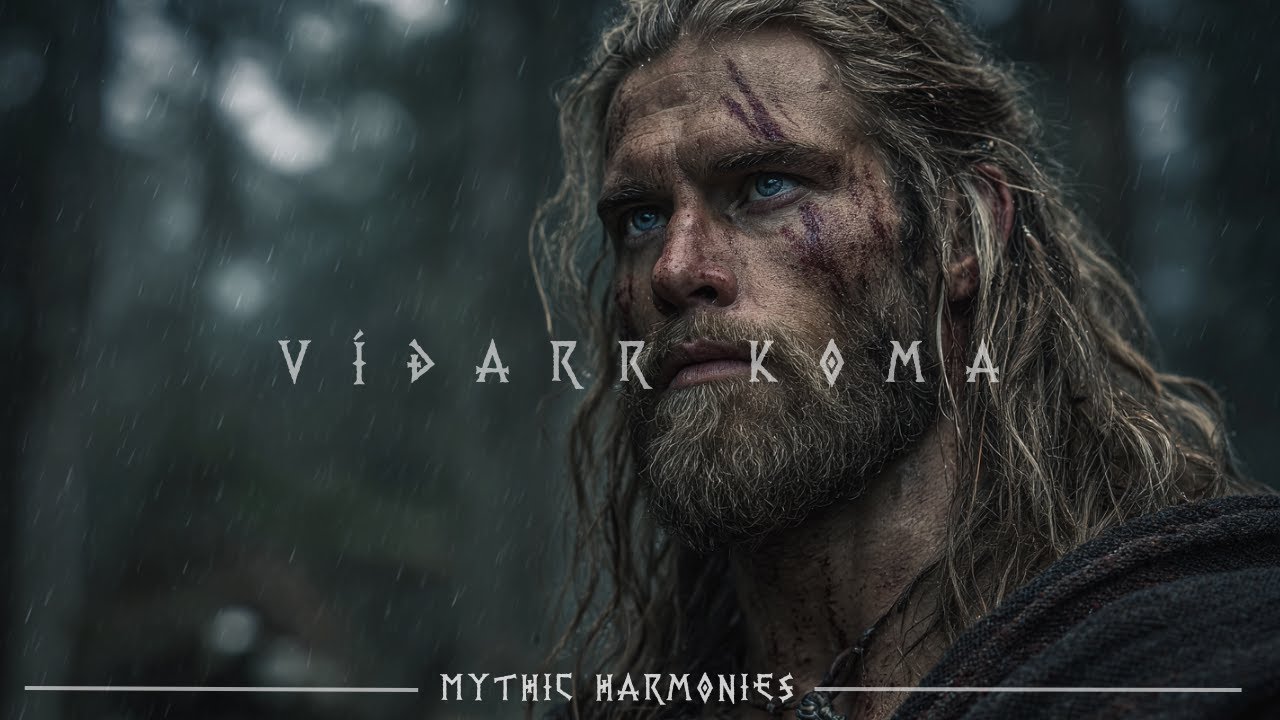
Víðarr Koma is a 2:48 Mythic Harmonies song about Víðarr’s silent approach. Its opening hears footsteps, its refrain repeats “Víðarr comes,” and its final movement turns old wounds into a restrained judgment that arrives without boast or prayer.
This music fiche keeps that specific recording at the center: identify the master, understand its title, follow the repeated approach, compare its Víðarr imagery with the medieval sources, then read the complete published text and English adaptation. It is a modern song, not an ancient chant or a transcript of Ragnarök.
Víðarr Koma at a Glance
- Site title: Víðarr Koma
- Distributed title: Víðars Koma
- Artist: Mythic Harmonies
- Runtime: 2:48 on YouTube, Spotify and Apple Music
- Language: stylized Old Norse with a published English artistic adaptation
- Song focus: silence, approaching footsteps, stored strength and delayed judgment
- Mythic focus: Víðarr as Odin’s avenger and a survivor beyond Ragnarök
What Does Víðarr Koma Mean?
The intended meaning is clear from the refrain: Víðarr kemr means “Víðarr comes.” The page title uses koma, which can be the infinitive “to come” or a noun meaning a coming or arrival; it is not the ordinary third-person singular verb used in the refrain.
The distributed form Víðars Koma can be read as “Víðarr’s coming” or “the coming of Víðarr.” Both release forms identify the same 2:48 master. The fiche preserves them rather than silently rewriting the title and pretending that every platform displays an identical normalized phrase.
What Story Does the Song Tell?
The song begins before any confrontation. Silence is heavy, footsteps approach, and Víðarr enters a dark forest with a steady hand. The first refrain repeats his arrival four times: he comes, stands, strikes and remains alone. Repetition makes movement feel slower rather than faster.
The middle verse introduces watching gods, old wounds, memory and delayed judgment. The refrain returns unchanged, so the promised strike still has not become a detailed combat scene. Only the last variation removes fury and mercy and gives silence itself the action. The final single name leaves the character present after the words stop.
This is therefore a song about approach and reserve, not a full retelling of Fenrir’s death. The myth explains why Víðarr matters; the track’s own identity is the tension before and after one unspecified “true strike.”
Why Is Víðarr Called the Silent God?
Snorri Sturluson explicitly calls Víðarr “the silent god” in Gylfaginning. The prose names him as a son of Odin and the giantess Gríðr, describes his thick shoe, and says he is almost as strong as Thor. This gives the song a real medieval epithet and a basis for its stored-strength imagery.
Silence should not be expanded into a complete psychology. The sources do not say that Víðarr feels no anger, never hesitates or uses silence as a supernatural weapon. In Lokasenna, he even rises at Frigg’s request and pours Loki a drink. He does not speak there, but he does act before Ragnarök, so “acts only once in all mythology” is too absolute.
Víðarr, Odin and Fenrir
The central source-based link is vengeance. At Ragnarök, Fenrir kills Odin and Víðarr answers the wolf. The song never names Fenrir or describes the killing method, so its footsteps and strike are best understood as a compressed approach to that role rather than a complete narrative.
The sources preserve different versions. In Vǫluspá, Víðarr advances against the beast and drives a sword into its heart. Snorri’s Gylfaginning instead emphasizes the special shoe: Víðarr braces Fenrir’s lower jaw, grips the upper jaw and tears the mouth apart. Neither version says that the gods silently watch without prayer exactly as this song describes.
The detailed comparison of sword, shoe and wolf belongs to Vidar’s Vengeance. The evidence-led profile of Fenrir and the site’s Ragnarök chronology retain the encyclopedic search intent.
Judgment, Fate and the Song’s Invention
“Judgment comes late, but steady” is one of the track’s defining lines. It turns Víðarr’s delayed appearance into a moral image: old injuries are remembered and reckoning arrives in its own time. That interpretation is coherent inside the song.
It is not a quotation from an Eddic poem or evidence for one universal Norse doctrine of cold, inevitable justice. The medieval sources foretell Víðarr’s vengeance, but the forest walk, no-prayer tableau, emotional restraint and abstract “judgment” are contemporary storytelling choices.
Does Víðarr Survive Ragnarök?
Yes. Vafþrúðnismál says that Víðarr and Váli will inhabit the gods’ sanctuaries after Surtr’s fire dies down. Snorri likewise includes them among the surviving gods in the renewed world. The final English phrase “still stands” can therefore echo an attested outcome.
The song compresses survival into attitude: silence remains after the strike. The sources do not frame survival as proof that Víðarr embodies judgment itself, and he is not the only survivor. That boundary keeps a real mythic endpoint without turning the track’s metaphor into doctrine.
How Silence Shapes the Recording
Short clauses and repeated stops create the track’s restraint on the page: “Silence lies heavy,” “Footsteps approach,” “Víðarr comes.” The refrain returns with the same name at the start of each line, making the character’s arrival the structural pulse. The final isolated “Víðarr…” removes resolution rather than supplying a victory speech.
These features can be verified from the released text and recording. Without full public production credits, the fiche does not invent a specific historical instrument, ritual vocal technique, key, frequency or psychological effect. Listeners may use the music as they choose, but concentration, dread or control are responses rather than guaranteed benefits.
Is Víðarr Koma an Authentic Viking Age Chant?
No. Víðarr Koma is an original modern Mythic Harmonies composition. The silent epithet, Odin’s death, Víðarr’s vengeance and his survival have medieval foundations. The forest, footsteps, old wounds, repeated judgment and complete wording do not survive as a Viking Age song.
The source-language text is stylized rather than uniformly normalized. The title’s koma differs from the refrain’s finite kemr; forms such as hljóðr ok fast, kraftur safnaðr, augun, minnið, engi óðr and þögn hans veggr should not be presented as transparent equivalents of every English line. Both published blocks are preserved below without silent correction.
How This Fiche Avoids Cannibalization
Víðarr Koma owns the 2:48 master, the approaching footsteps, repeated Víðarr kemr refrain, no-prayer scene and “still stands” ending. Vidar’s Vengeance owns the killing of Fenrir and the shoe traditions. Fenrir Rís owns the wolf’s release and ascent; Ragnarǫk Rís owns the larger world-ending ensemble.
Those boundaries link related listening paths without making each fiche target the same general “Víðarr mythology” or “Ragnarök” query. The complete text, translation and exact platforms remain unique to this song.
Source Notes
- Snorri Sturluson’s Edda: Prologue and Gylfaginning, Viking Society for Northern Research: the silent epithet, Gríðr, strength, thick shoe, Fenrir’s jaws and the renewed world.
- The Poetic Edda, edited and translated by Edward Pettit: Vǫluspá for the sword tradition, Vafþrúðnismál for Víðarr’s survival and Lokasenna for his action at the feast.
- Dictionary of Old Norse Prose, University of Copenhagen: lexical control for koma, koma/kemr, þǫgn, dómr and the released forms.
Where to Listen to Víðarr Koma
Watch the official 2:48 video at the top of this fiche. The matching Mythic Harmonies master is distributed as Víðars Koma at 2:48 on Spotify and Apple Music. Artist, album and duration match exactly.
Víðarr Koma Lyrics & English Adaptation
The two blocks preserve the released transcription and English artistic adaptation exactly. They are the words of this modern recording, not a medieval edition.
Original Text (Stylized Old Norse)
Þögn liggr þung. Skref nálgast. Víðarr kemr.
Í skógi dimmum gengr hann ró,
fótr á jǫrð, hönd er föst.
Engi reiði, engi orð,
kraftur safnaðr, bundinn djúpt.Víðarr kemr. Hljóðr ok fast.
Víðarr kemr. Stendr í þögn.
Víðarr kemr. Högg er satt.
Þegjandi guð. Stendr einn.Goð bíða, augun sjá,
engin hróp, engi bæn.
Sár eru gömul, minnið þungt,
dómr kemr seint, en stöðugr.Víðarr kemr. Hljóðr ok fast.
Víðarr kemr. Stendr í þögn.
Víðarr kemr. Högg er satt.
Þegjandi guð. Stendr einn.Víðarr kemr. Engi óðr.
Víðarr kemr. Engi miskunn.
Víðarr kemr. Þögn hans veggr.
Þegjandi guð. Stendr enn.Víðarr…
English Artistic Adaptation
Silence lies heavy. Footsteps approach. Víðarr comes.
In the dark forest he walks calm,
Foot on earth, hand steady.
No rage, no words,
Strength gathered, bound deep.Víðarr comes. Silent and firm.
Víðarr comes. He stands in silence.
Víðarr comes. The strike is true.
The silent god. Stands alone.The gods wait, their eyes see,
No cries, no prayer.
Wounds are old, memory heavy,
Judgment comes late, but steady.Víðarr comes. Silent and firm.
Víðarr comes. He stands in silence.
Víðarr comes. The strike is true.
The silent god. Stands alone.Víðarr comes. No fury.
Víðarr comes. No mercy.
Víðarr comes. His silence strikes.
The silent god. Still stands.Víðarr…
What does Víðarr Koma mean?
The intended meaning is “Víðarr comes,” expressed in the refrain as Víðarr kemr. The page title uses koma, while the distributed title Víðars Koma can be read as “Víðarr’s coming.”
What is the song Víðarr Koma about?
The 2:48 song builds tension around silent footsteps, stored strength and a delayed strike. It evokes Víðarr’s role as Odin’s avenger but stops short of narrating Fenrir’s death in full.
Why is Víðarr called the silent god?
Snorri explicitly calls Víðarr the silent god. The sources do not explain a complete psychology for the epithet, and Lokasenna shows him acting at the gods’ feast even though he does not speak there.
Is Víðarr Koma an authentic Viking Age chant?
No. It is an original modern Mythic Harmonies composition in stylized Old Norse. Medieval sources support Víðarr’s epithet, vengeance and survival, but not this lyric, melody or ritual atmosphere.
Where can I listen to Víðarr Koma?
The official video runs 2:48 on YouTube. The same 2:48 Mythic Harmonies master is distributed as Víðars Koma on Spotify and Apple Music.
More from Mythology & Gods
March with the War-Band
New Old Norse chants every month. Join the listeners who never miss a release.