
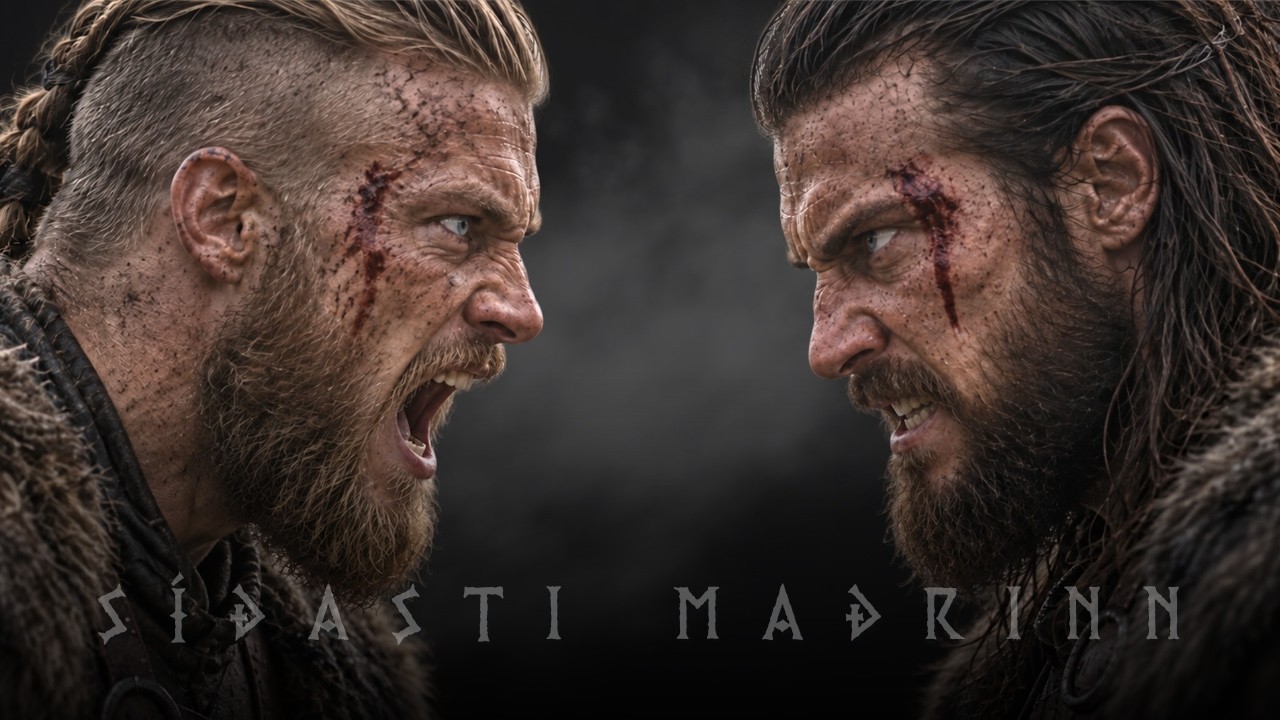
SÍÐASTI MAÐRINN, “The Last Man,” is a Mythic Harmonies single released on 1 October 2026. An unnamed defender is left standing between an advancing enemy and the children behind him. The song begins among the fallen and ends with a statement about what his resistance achieved, while leaving his own fate open.
The title (The Last Man) describes a position that becomes a responsibility. At first, the speaker seems simply to be the sole survivor of his group. As the verses unfold, his refusal to move acquires a purpose: buying life and time for people who have not yet known war. The complete original words, English translation and official recording appear below.
SÍÐASTI MAÐRINN Meaning: The Last Man Holding the Line
The title’s meaning is “The Last Man.” In the refrain, the shorter phrase síðasti maðr returns as the speaker’s defining description. He receives no personal name, rank or lineage. What identifies him is being the one who remains. That gives the refrain a particular force: each repetition measures the same fragile situation against the continued fact of his presence.
The vocabulary has an Old Norse background: maðr means “man,” and maðrinn is its definite form. Michael Barnes’s A New Introduction to Old Norse explains both the noun and the suffixed article (§§3.1.1, 3.1.9). This helps explain the title without treating the whole song as a medieval text.
An Opening After the Battle Has Already Taken Its Toll
The opening gives the consequences before the reasons: everyone has fallen, the speaker stands alone, and blood marks both sword and ground. There is no account of marching to war or choosing an enemy. By beginning after those possibilities have narrowed, the words place the listener inside an immediate decision. Moving away is imaginable, but the narrator repeatedly refuses it.
The next lines widen the threat: the attackers keep coming, in increasing numbers. The lyric does not describe a tactical formation, a named battlefield or a particular enemy people. Its viewpoint remains close to the defender. This matters when reading the scene: the song supplies the pressure of an encounter, rather than a historical campaign that can be reconstructed from its details.
Why the Children Change the Meaning of the Fight
The second verse provides the story’s decisive information. The speaker says that he fights neither for gods nor for gold. Behind him stand children who know no war. Those lines move the purpose of the stand away from reward and toward protection. The children are not described as his own, and the text gives no family relationship that would justify calling him their father.
The following stanza connects each enemy brought down with a child who lives, and each wound borne with another day. These are the defender’s words within a violent scene. Read together, they make time the thing he is trying to secure. His body takes the cost while the people behind him retain a possible future. The English translation preserves that direct connection without adding an escape, rescue or later reunion.
This is also why the first-person voice does not make the story purely solitary. He stands alone in the fighting, but his actions concern people other than himself. The chorus can therefore be heard as a promise made on their behalf: the enemy’s movement stops where his continued resistance begins.
“I Am Afraid”: The Admission at the Centre of the Song
The bridge changes the kind of statement being made. After repeated refusals to turn away, the narrator admits that he is afraid and has always been afraid. The song does not describe fear vanishing or a supernatural power taking its place. Instead, attention settles on his feet: they are still standing. The physical detail makes courage something he continues to do while fear is present.
A useful comparison is Hávamál, stanza 16, where avoiding conflict is shown not to grant immortality: age still brings an end. The Olive Bray translation hosted by the University of Pittsburgh allows that older treatment of mortality to be read beside the song. The comparison is limited. SÍÐASTI MAÐRINN’s particular reason for remaining, the children behind its speaker, belongs to this modern story; it is not a retelling of that stanza.
Does the Last Man Survive?
The chorus promises an outcome conditionally: as long as the speaker stands, the attackers will not get through. The closing words move to the past: “They did not get through.” That is the clearest resolution the song gives. The repeated “I stand!” has become an accomplished defence, rather than only a vow about what he intends to do.
His survival is not settled by those final words. There is no explicit death, burial, return home or entrance into Valhalla. Reading the ending as either a survivor’s report or a final testimony is possible, but neither is established as the only answer. The definite achievement is the line held; leaving the man’s fate unstated preserves the human cost behind that achievement.
Language and Translation Notes
The song uses modern, stylized Nordic wording inspired by Old Norse, preserved below exactly as released. It combines older-looking forms with language that does not consistently follow normalized Old Norse grammar. For example, the song’s ek er contrasts with ek em in Barnes’s paradigm of “to be” (§3.6.10). The English rendering follows the intended narrative meaning. It does not silently revise the sung original or present it as a manuscript edition.
SÍÐASTI MAÐRINN: Track Facts
| Artist | Mythic Harmonies |
|---|---|
| Title | SÍÐASTI MAÐRINN |
| English meaning | The Last Man |
| Release date | 1 October 2026 |
| Duration | 2:54 |
| Language | Modern stylized Nordic lyrics inspired by Old Norse |
| Label | Mythic Harmonies |
| Listen | Spotify: song · Apple Music: song |
SÍÐASTI MAÐRINN Lyrics and English Translation
Read the complete original text and its English rendering below. Every repeated refrain is retained, including the closing lines.
Original Lyrics
allir féllu
ek stend einn
blóð á sverði
blóð á jörðuþeir koma enn
fleiri ok fleiri
en ek snýr ekki
ek snýr aldrisíðasti maðr
síðasti maðr
á meðan ek stend
komast þeir ekki fram
síðasti maðrek berjast ekki fyrir guðum
ek berjast ekki fyrir gulli
á bak mér standa
börn sem þekkja ekki stríðhverr riddari sem ek drep
er eitt barn sem lifir
hvert sár sem ek ber
er einn dagr tilsíðasti maðr
síðasti maðr
á meðan ek stend
komast þeir ekki fram
síðasti maðrek er hræddur
ek hef alltaf verið hræddur
en hræðslan skiptir engu
aðeins fœturnir skipta máli
ok fœturnir standa ennsíðasti maðr
síðasti maðr
á meðan ek stend
komast þeir ekki fram
síðasti maðr
ek stend!
síðasti maðr
ek stend!þeir komust ekki fram
síðasti maðr
þeir komust ekki fram
English Translation
They all fell
I stand alone
Blood on my sword
Blood on the groundThey keep coming
More and more of them
But I will not turn
I will never turnThe last man
The last man
As long as I stand
They will not get through
The last manI do not fight for gods
I do not fight for gold
Behind me stand
Children who know no warEvery rider I kill
Is one child who lives
Every wound I bear
Is one more dayThe last man
The last man
As long as I stand
They will not get through
The last manI am afraid
I have always been afraid
But fear does not matter
Only my feet matter
And my feet are still standingThe last man
The last man
As long as I stand
They will not get through
The last man
I stand!
The last man
I stand!They did not get through
The last man
They did not get through
Release Credits
Lyrics: Calogero Nicosia. Production: Calogero Nicosia. Artist: Mythic Harmonies.
Listen to SÍÐASTI MAÐRINN
Open the recording: Spotify · Apple Music · Official music video.
For the wider catalogue, visit the Mythic Harmonies artist profile on Amazon Music.
For another lone voice under pressure, listen to SKJÖLDR MÍNN, where holding one’s ground becomes a message entrusted to a brother. Vér stǫndum featuring Vigruna offers the collective counterpart: protection shared between people standing together. Follow their original words in the Mythic Harmonies songbook.
Sources and Further Reading
Michael Barnes, A New Introduction to Old Norse, Part I: Grammar, third edition (2008). Viking Society for Northern Research. §§3.1.1 and 3.1.9 explain the noun and definite article; §3.6.10 supplies the language comparison.
Hávamál, translated by Olive Bray, edited online by D. L. Ashliman, University of Pittsburgh. Stanza 16 is a comparative reading on mortality, not a source attribution for the song.
Frequently Asked Questions
What does SÍÐASTI MAÐRINN mean?
The title means “The Last Man.” It identifies the unnamed defender who remains standing after the others have fallen. The shorter phrase “síðasti maðr” repeats in the chorus.
Who is the last man fighting for?
He says that he fights neither for gods nor for gold, but for the children standing behind him. The lyrics do not identify a named battle, historical warrior or family relationship between the defender and those children.
Does the narrator die at the end of SÍÐASTI MAÐRINN?
The lyrics do not explicitly say. The final words, “They did not get through,” confirm the defence succeeded, while leaving the narrator’s survival open.
Are the words an authentic medieval Old Norse text?
No. This is a contemporary song with stylized Nordic wording inspired by Old Norse. The original words and repetitions are preserved alongside an English rendering of their intended meaning.
When was SÍÐASTI MAÐRINN released, and where can I listen?
Mythic Harmonies released the single on 1 October 2026. The Spotify recording runs for 2:54. This page includes the official video and direct links to the song on Spotify and Apple Music.
More from Epic War Battle
March with the War-Band
New Old Norse chants every month. Join the listeners who never miss a release.