
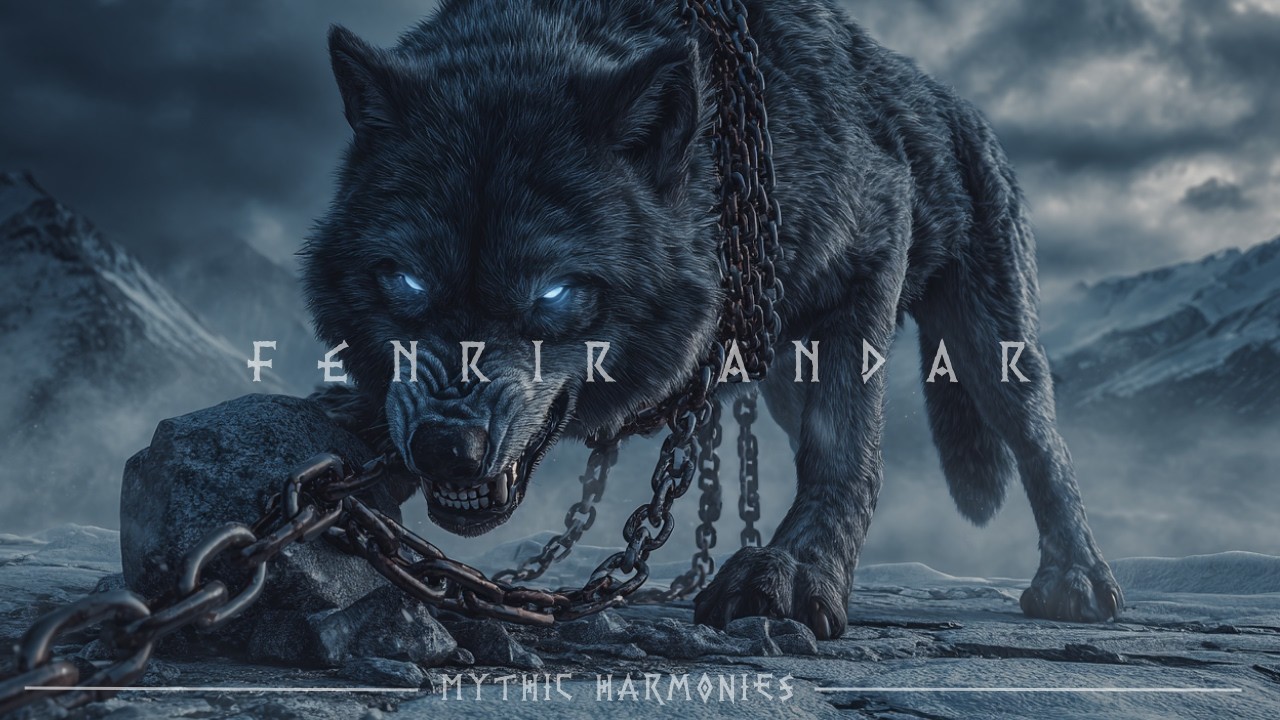
What Is FENRIR ANDAR?
FENRIR ANDAR (“Fenrir Breathes”) is a 3:46 Mythic Harmonies Old Norse wolf chant about the terror before release. Fenrir remains bound, but every breath makes iron, stone and the world around him answer.
- Artist: Mythic Harmonies
- Recording: 3:46 on YouTube
- Language: stylised Old Norse with English translation
- Mythic focus: Fenrir waiting beneath his binding
- Search identity: suspense and breathing before the break, not the release itself
The Song’s Story: The Wolf Still Bound
The opening keeps Fenrir in darkness under pressure from a fetter. Breath replaces movement: the earth remembers former steps, chains sound against stone and the roots of the ash tremble. Only late in the lyric does iron break and the wolf rise.
That slow escalation makes the track different from an immediate Ragnarök anthem. The recurring phrase “Fenrir breathes” measures time like a drum. Dread grows because release is delayed.
Gleipnir, Iron and Creative Geography
In Gylfaginning, Fenrir is bound by Gleipnir, a magical fetter that looks smooth and light rather than like an ordinary iron chain. The song’s iron, stone hall and mountain imagery are cinematic additions. They should not replace Snorri’s description.
Likewise, the ash tree’s roots trembling and runes falling into earth are original images. They connect Fenrir’s private confinement to cosmic scale without claiming an archaeological or manuscript scene.
What the Sources Say About the Waiting Wolf
The medieval narrative explains why the gods fear Fenrir, how Týr loses his hand and how the wolf remains bound until Ragnarök. It does not provide a long interior portrait of Fenrir breathing stronger in darkness. This recording fills that silence from outside.
Odin’s awareness from a high seat also condenses several mythological associations. The composition makes the god watch his future killer; the evidence-led Fenrir guide separates those source layers.
Fenrir Andar vs. the Other Fenrir Songs
FENRIR UNCHAINED begins with liberation. FENRIR RÍS owns the rising. FENRIR ANDAR owns the breath, waiting and subterranean tension before the event.
Its longer bilingual lyric also gives it a distinct retention pattern: each verse adds one physical response—chain, stone, root, sky—until the world itself becomes the listener.
Týr’s Hand and the Cost of Binding
The most personal cost in Snorri’s binding story belongs to Týr. Fenrir agrees to test Gleipnir only if a god places a hand in his mouth as a pledge. When the wolf discovers that he cannot break free, all the gods laugh except Týr, who loses the hand. The episode gives the fetter a moral price as well as a magical function.
FENRIR ANDAR does not narrate that bargain, but its pressure and waiting make more sense beside it. The bound wolf is not merely sleeping; he has experienced deception and is held for a future the gods already fear. The song’s breath becomes the audible remainder of that unresolved act.
Ragnarök Approaches Quietly
The lyric says Ragnarök draws near in silence, then eventually declares that it has come. Medieval sources stage the catastrophe through many signs and actors, not one breath alone. Fenrir’s escape belongs to the larger collapse involving gods, monsters, fire and cosmic renewal.
This fiche therefore resists making the wolf the sole cause of Ragnarök. The recording concentrates the event around him for narrative tension; the mythology article restores the wider sequence. That separation protects both the song’s focus and the accuracy of the informational architecture.
A Modern Soundscape, Not an Excavated One
Tagelharpa, low percussion and cinematic drones create an imagined subterranean North. The combination is a contemporary production language. Archaeology cannot recover this exact tempo, harmony or studio texture, and the page does not pretend otherwise.
That honesty leaves room for a precise artistic claim: every layer delays the break. The listener hears a body, a chain and an approaching world-change before seeing any action.
FENRIR ANDAR Lyrics and English Translation
Editorial note: the Old Norse text below preserves the official words released by Mythic Harmonies. It is a modern, stylised lyric, not a quotation from a medieval manuscript or a claimed reconstruction of Viking Age performance.
Old Norse Lyrics
English Translation
Listen on YouTube, Spotify and Apple Music
The exact FENRIR ANDAR video runs 3:46. No same-title Spotify or Apple Music master has been verified within one second, so the page uses the Mythic Harmonies Spotify and Apple Music artist pages.
Sources and Further Reading
- Viking Society for Northern Research, Snorri Sturluson, Gylfaginning, for Fenrir and Gleipnir.
- Viking Society for Northern Research, Völuspá, for Ragnarök context.
- Dictionary of Old Norse Prose, University of Copenhagen, for lexical checking.
What does FENRIR ANDAR mean?
The intended title means “Fenrir Breathes.”
Is FENRIR ANDAR an authentic Old Norse chant?
No. It is a modern composition in stylised Old Norse.
Was Fenrir bound with iron chains?
Snorri’s decisive fetter is Gleipnir, smooth and magical. The iron-chain setting is modern imagery.
How is this different from FENRIR UNCHAINED?
FENRIR ANDAR builds suspense while the wolf is bound; FENRIR UNCHAINED focuses on release.
Where can I listen to FENRIR ANDAR?
The exact 3:46 recording is on the official YouTube video.
More from Mythology & Gods
March with the War-Band
New Old Norse chants every month. Join the listeners who never miss a release.