
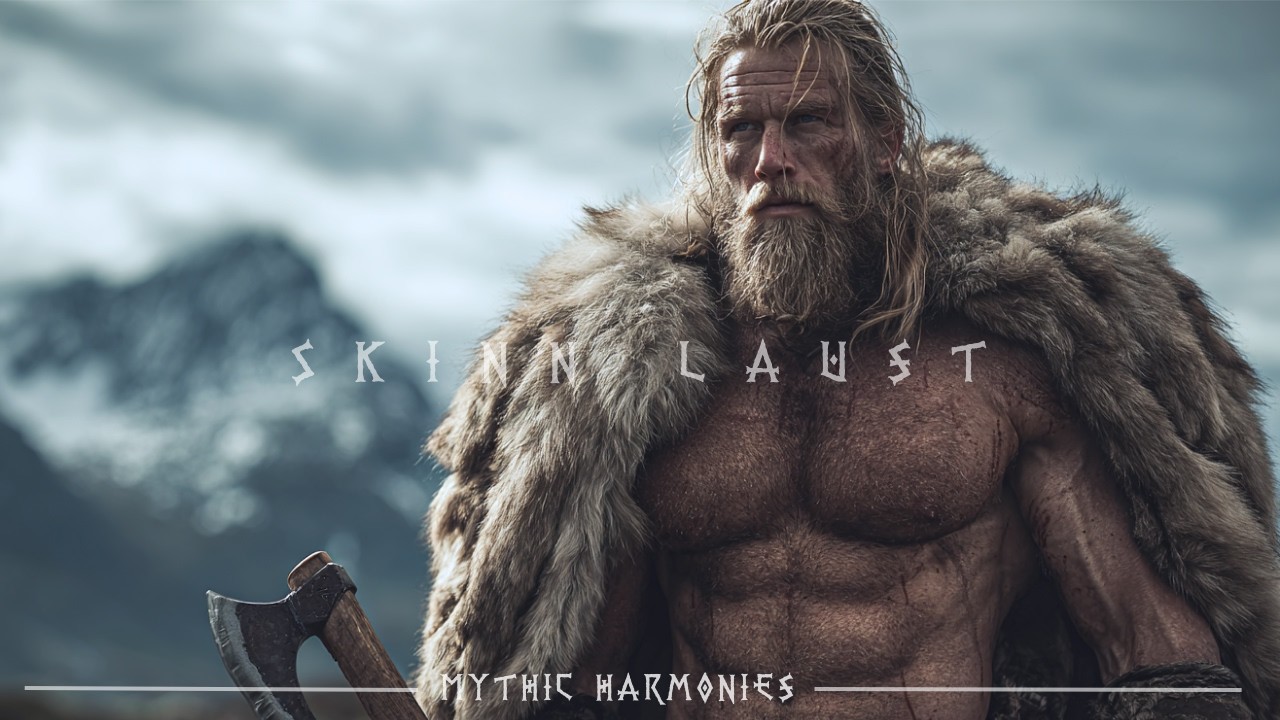
What Is Skinn Laust?
Skinn Laust (“Skin Loose”) is a 3:33 Mythic Harmonies berserker chant in stylized Old Norse. It follows a wounded fighter who keeps moving after flesh, bone and weapon have failed, until the fury finally cools.
- Artist: Mythic Harmonies
- Official video: 3:33 on YouTube
- Language: stylized Old Norse with an official English adaptation
- Core scene: a berserker advances despite catastrophic wounds
- Historical status: an original modern battle song, not a surviving Viking Age chant or medical account
The medieval record does associate berserkers with extraordinary battle fury. It does not prove literal immunity to blades, a universal pain-free trance or the exact transformation staged in this song. The fiche keeps those two levels separate: the lyric is vivid fiction; the sources document how later Old Norse texts describe berserksgangr.
The Song’s Story: Wounded, Still Standing
The opening compresses the entire premise into three blows: skin tears, the wound opens, the berserker stands. Heat and cold then collide as blood crosses frozen earth. The sword enters deeply, but pain no longer governs the speaker’s movement.
The refrain turns the title into a command-state. “Skinn laust” is paired with a hard mind, absent pain and a march toward death’s hall. The next verse makes the body increasingly untenable—spear in the side, iron in the chest—while the warrior is described as steel and as a fosterling of the wild beast.
The final return changes the meaning of “still standing.” The song does not grant invulnerability. A body can fall even when the person’s resolve does not. Blood cools in the last line, ending the trance without pretending that rage defeats mortality.
What Does Skinn Laust Mean?
Skinn means skin or hide, while laust can convey loose, free or detached according to context. “Skin Loose” is the official title translation. In the song it is not an archaeological phrase or named historical rite; it is a poetic image for the moment the fighter treats his damaged body as something already left behind.
What Medieval Sources Actually Say About Berserkers
Snorri Sturluson’s Ynglinga saga gives the most frequently repeated description: Odin’s men went without mail, were mad like dogs or wolves, bit their shields and were strong like bears or bulls. It also says that neither fire nor iron affected them. This is a thirteenth-century literary account of a much earlier legendary past, not a clinical observation recorded during a Viking battle.
Other sagas use berserkers in different roles—as champions, dangerous outsiders, supernatural opponents or figures whose rage changes their appearance and conduct. Modern scholarship therefore treats “the berserker” as a complex literary and cultural problem, not one fully recoverable warrior program.
Bear-Shirt, Bare-Shirt or Something Less Certain?
The first element of berserkr has often been explained as “bear,” producing “bear-shirt.” Another long-standing proposal reads it as “bare,” suggesting a fighter without armour. Animal imagery is certainly important in the literary tradition, but a neat one-sentence etymology should not be presented as settled proof of a universal uniform.
Skinn Laust deliberately works with both possibilities: hide and flesh, beast and unarmoured body. That is artistic layering, not evidence that the title preserves an old technical name.
Does Berserker Rage Make a Fighter Feel No Pain?
The lyric repeatedly says that the speaker feels no pain. Medieval prose can depict berserkers as unaffected by weapons, but the historical mechanism is unknown. Suggestions involving drugs, psychiatric states, ritual performance or trained arousal remain debated and cannot be diagnosed from saga scenes alone.
The responsible reading is therefore dramatic: the song gives a first-person voice to legendary invulnerability. It should not be used as evidence that Viking fighters literally ignored mortal wounds or followed one documented berserker ritual.
Language and Translation Note
The released text is modern, rhythm-led Old Norse rather than a quotation from an Eddic poem. Several forms are compressed or non-normalized. For example, the official line sár tala ei, ek finn ei þenn is intended as “wounds speak not, I feel nothing,” but its final wording is not standard prose. The English below is the official adaptation and the clearest guide to the intended story.
How This Berserker Track Stays Distinct
This fiche owns the title Skinn Laust, the 3:33 master, bodily rupture and the “feels no pain” refrain. Berserkr’s Call is built around a different inherited-poetry hook, while Bjarkamál centres a named legendary poem and Bǫðvarr Bjarki. The links clarify the berserker cluster without asking three pages to rank for one recording.
Skinn Laust Lyrics
The complete text follows the official video description.
Old Norse
Skinn slitnar. Sár opnast. Berserkir… stendr.
Blóð rennr heitt um kalda jǫrð,
hold er rifit, hugr er harðr.Sverðr kemr djúpt, berserkir stendr,
sár tala ei, ek finn ei þenn.Bein brotnar. Eldr deyr.
Skinn er laust. Berserkir fer.Berserkir! Skinn laust!
Sár ok blóð, en hugr fast.
Berserkir! Finn ei kval!
Ek geng fram, í dauðans sal!Augun sjá, en sál er tóm,
berserkir gengr í dauðans dóm.Spjót í síðu, járn í brjóst,
berserkir stendr, villidýr fóstr.Engi sársauki. Engi grát.
Blóð eitt rennr. Berserkir stál.Berserkir! Skinn laust!
Sár ok blóð, en hugr fast.
Berserkir! Finn ei kval!
Ek geng fram, í dauðans sal!Berserkir! Stendr enn!
Fallinn lík, en eigi menn.
Berserkir! Til enda fer!
Skinn er laust, þar til ek fellr!Blóð… berserkir… kólnar.
English Translation
The skin tears. The wound opens. The berserker… stands.
Blood runs hot across the cold earth,
flesh is torn, the mind is hard.The sword cuts deep, the berserker stands,
wounds speak not, I feel nothing.Bone breaks. Fire fades.
Skin comes loose. The berserker moves on.Berserker! Skin loose!
Wounds and blood, but the mind holds.
Berserker! Feels no pain!
I march forward, into the hall of death!The eyes see, but the soul is empty,
the berserker walks into death’s judgment.Spear in the side, iron in the chest,
the berserker stands, raised by the wild beast.No pain. No grief.
Only blood runs. The berserker is steel.Berserker! Skin loose!
Wounds and blood, but the mind holds.
Berserker! Feels no pain!
I march forward, into the hall of death!Berserker! Still standing!
A fallen body, but not a fallen man.
Berserker! Goes until the end!
Skin comes loose, until I fall!Blood… berserker… grows cold.
Listen to the Official Recording
Watch the official 3:33 Skinn Laust video on YouTube. No exact same-title Mythic Harmonies master was found on Spotify or Apple Music under the catalogue’s title, artist and ±1-second duration rule, so the fiche uses the verified Spotify and Apple Music artist pages rather than linking a different song.
Sources and Further Reading
- Alison Finlay and Anthony Faulkes (trans.), Heimskringla I, for Snorri’s literary description of Odin’s berserkers in Ynglinga saga.
- Cambridge University Press, “Shape, Monstrosity and Berserkism in the Íslendingasögur”, for the variety of medieval literary representations.
- Edward Pettit (ed. and trans.), The Poetic Edda: A Dual-Language Edition, for the broader Old Norse poetic context.
What does Skinn Laust mean?
The intended title translation is Skin Loose. In the song it describes a berserker treating torn flesh and pain as things already left behind; it is a modern poetic title, not an attested Viking ritual term.
What is the Skinn Laust song about?
A badly wounded berserker continues through sword, spear and broken bone until his blood finally cools. The song contrasts mortal bodily damage with an unbroken will.
Is Skinn Laust an authentic Viking berserker chant?
No. It is an original modern Mythic Harmonies composition in stylized Old Norse. Medieval texts describe berserker fury, but they do not preserve this title, wording, character or melody.
Did berserkers really feel no pain?
Medieval literature sometimes portrays berserkers as unaffected by weapons, but it does not provide clinical proof or one established mechanism. The song uses legendary invulnerability as first-person drama.
Where can I listen to Skinn Laust by Mythic Harmonies?
The verified official recording is the 3:33 YouTube video. No same-title artist-and-duration match was confirmed on Spotify or Apple Music, so the fiche uses Mythic Harmonies artist-page fallbacks.
More from Epic War Battle
March with the War-Band
New Old Norse chants every month. Join the listeners who never miss a release.