
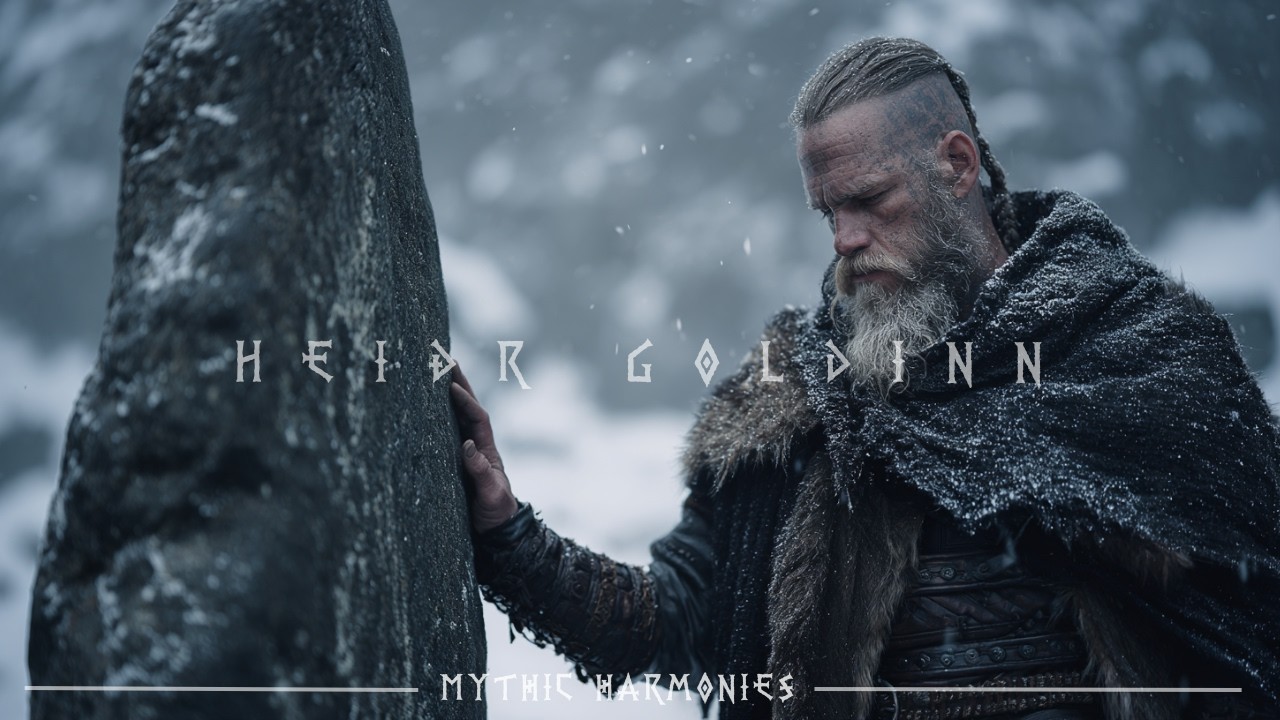
What Is Heiðr Goldinn?
Heiðr Goldinn, presented in English as Honour Paid, is a 2:52 original Mythic Harmonies memorial chant in stylized Old Norse with an official English translation. It follows an unnamed fallen person whose public traces disappear while private remembrance endures.
- Artist: Mythic Harmonies
- Official video: 2:52 on YouTube
- Languages: stylized Old Norse with official English translation
- Intended title meaning: Honour Paid
- Core theme: remembrance without praise, monument or surviving name
- Historical status: modern poetic memorial, not a documented Viking funeral chant
The fiche separates three layers that are easy to blur: the song’s intended translation, historical evidence for commemoration and the modern narrative. Viking Age runestones often were raised by relatives in memory of the dead. That evidence supports the setting of remembrance; it does not prove that these lyrics, this title or a rite called Heiðr Goldinn existed.
What Does Heiðr Goldinn Mean?
Mythic Harmonies gives the title the intended English sense “Honour Paid.” Goldinn is the past participle of a verb associated with paying or rendering. Heiðr can be read as honour in later usage, but the Cleasby–Vigfusson dictionary cautions that this honour sense does not occur in the oldest or classical writers.
That lexical warning is important. The title works as a modern poetic Old Norse construction, but it should not be advertised as a securely attested Viking Age formula. A transparent translation is stronger than a false claim of antiquity: “Honour Paid” is the composer’s intended meaning, with a historical-language caveat attached.
The Song’s Story: Remembrance Without a Monument
The opening rejects the expected instruments of fame. There is no cry, praise-song or visible trail; the sword falls and the hand is empty. Honour survives only “in the chest,” turning an abstract public value into an intimate burden carried by one witness.
The refrain sharpens the paradox: “No tale, no stone, only the heart bears witness.” A runestone normally makes memory public and durable. This song imagines the opposite condition—a death that leaves no carved name, with silence itself becoming the memorial.
The final lines move from individual loss to transmission. “Blood becomes memory” is metaphor, not a claim that Norse people believed biological blood stored experiences. The North remembers because a living voice continues to repeat the loss. The song therefore belongs to modern ancestral poetry, not to reconstructed religion.
What Viking Runestones Actually Tell Us About Memory
The Swedish National Heritage Board explains that most Viking Age runestones were memorial monuments and that relatives commonly commissioned them. Their formulas can identify the sponsor, the dead person and the relationship between them. This is direct material evidence for named commemoration, though every stone has its own date, place and wording.
Heiðr Goldinn deliberately removes that monument from its story. The lyric “no stone” should not be used to deny the importance of runestones; it creates a dramatic absence against a historically meaningful form of remembrance. For the catalogue’s track specifically about inherited blood-memory, see Blóð Minnist. This fiche remains focused on honour rendered through silent witness.
The frequently quoted stanzas of Hávamál about cattle, kin and the self dying while reputation does not are medieval literary evidence for the value of posthumous renown. They are not instructions for a funeral and do not describe this song’s scene. Used carefully, they provide a comparison rather than proof.
Musical and Narrative Design
At under three minutes, the track is concise: short statements, repeated silence and a refrain that returns without triumph. The absence of a named hero keeps the listener’s attention on memorial action rather than biography. It can accompany remembrance scenes, role-playing memorials or reflective listening, but those contemporary uses should not be mistaken for Viking ritual reconstruction.
Its search intent is also intentionally separate from nearby songs. Blóð Minnist asks how memory travels through descendants; Heiðr Goldinn asks how respect can be rendered when names, stories and stones are gone. Other battle tracks centre courage, formation or victory.
Heiðr Goldinn Lyrics and English Translation
The bilingual lyrics below follow the official Mythic Harmonies video description. The Old Norse is a stylized modern lyric, not a manuscript transcription or a claim of native-speaker reconstruction.
Old Norse
Þǫgn stendr. Blóð man.
Eigi hróp, eigi lofsǫng, spor váru dulin í frosti kaldu.
Sverð féll niðr, hǫnd varð tóm, en heiðr lifði í brjósti einu.
Orð deyja. Nöfn fjúka. Heiðr stendr.
Heiðr goldin í þǫgn. Blóð eitt veit.
Engi sǫgn, engi steinn, nema hjarta ber vitni.
Heiðr goldin í þǫgn. Einn fellr.
Norðr man.
Engi gröf heldr Norðr, jörð tók við án tára.
Sár vóru djúp, ei sýnd, í skugga gekk dómr stillr.
Engi grátr. Engi bæn. Heiðr bundin.
Heiðr goldin í þǫgn. Blóð eitt veit.
Engi sǫgn, engi steinn, nema hjarta ber vitni.
Heiðr goldin í þǫgn. Einn fellr.
Norðr man.
Heiðr goldin í þǫgn. Allt lifir.
Þó ek fall, þó orð deyi,
verðr blóð at minni.
Þǫgn… Norðr man.
English Translation
Silence stands. Blood remembers.
No cry, no praise-song, the tracks were hidden in the cold frost.
The sword fell down, the hand became empty, but honour lived in the chest alone.
Words die. Names scatter. Honour stands.
Honour paid in silence. Only blood knows.
No tale, no stone, only the heart bears witness.
Honour paid in silence. One falls.
The North remembers.
No grave holds the North, the earth received him without tears.
The wounds were deep, not shown, in shadow the quiet judgment walked.
No weeping. No prayer. Honour bound.
Honour paid in silence. Only blood knows.
No tale, no stone, only the heart bears witness.
Honour paid in silence. One falls.
The North remembers.
Honour paid in silence. All lives on.
Though I fall, though words die,
blood becomes memory.
Silence… the North remembers.
Listen to the Official Recording
Watch the verified 2:52 Heiðr Goldinn video on YouTube. No exact Mythic Harmonies title-and-duration match appeared on Spotify or Apple Music, so the fiche points safely to the official Spotify artist page and Apple Music artist page.
Sources and Further Reading
- Swedish National Heritage Board, Runestones, for the memorial purpose, commissioners and family relationships of many Viking Age stones.
- Cleasby and Vigfusson, An Icelandic–English Dictionary, heiðr, for the lexical caution attached to the “honour” sense.
- Edward Pettit, trans., The Poetic Edda, for the relevant Hávamál stanzas on death and reputation.
What does Heiðr Goldinn mean?
Mythic Harmonies intends the title to mean Honour Paid. Goldinn carries the sense of paid or rendered; the honour sense of heiðr needs a lexical caveat and should not be sold as a secure ancient formula.
What is Heiðr Goldinn about?
It is about honouring an unnamed fallen person when no praise-song, carved stone or surviving public story remains, leaving the heart as the witness.
Is Heiðr Goldinn a historical Viking funeral chant?
No. It is an original modern composition in stylized Old Norse. Viking runestones provide real memorial context, but not these lyrics or this rite.
Did all Vikings memorialize the dead with runestones?
No. Many surviving Viking Age runestones are memorials commissioned by relatives, but the archaeological record is selective and does not represent every person or funeral.
Where can I listen to Heiðr Goldinn?
The verified official recording is the 2:52 YouTube video. No exact Spotify or Apple Music master matched the title and duration, so artist-page fallbacks are used.
More from Epic War Battle
March with the War-Band
New Old Norse chants every month. Join the listeners who never miss a release.